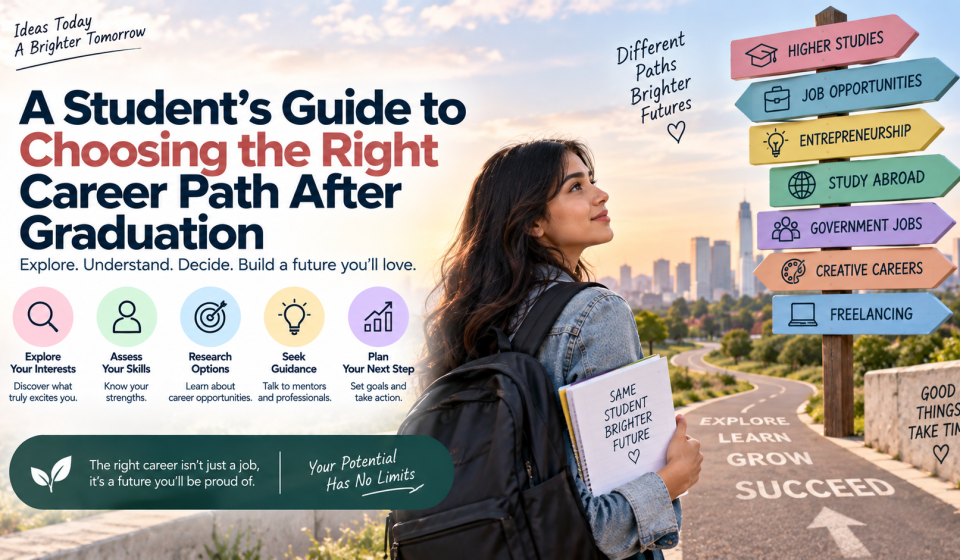

Discover how students can choose the right career path after graduation by evaluating skills, interests, education, job opportunities, goals, and long-term career growth.
Graduation is an important milestone, but it can also bring an important question: What should I do next? Students may have several career options, yet choosing the right direction can feel confusing when they are unsure about their interests, skills, qualifications, or future opportunities.
A career decision does not always have to be permanent. Many professionals change roles, industries, or career directions as they gain experience and discover new interests. However, making an informed decision after graduation can provide a stronger starting point.
Choosing a career path involves more than selecting a job with a good salary. Students should consider their abilities, interests, education, work preferences, career goals, financial expectations, and opportunities for professional development.
Understand Yourself Before Choosing a Career
The first step in career planning is understanding yourself. Students should think about what they enjoy doing, what they are naturally good at, and what type of work makes them feel motivated.
For example, a student who enjoys solving technical problems may explore technology-related careers. Someone who enjoys communication and organizing people may consider careers in management, marketing, human resources, education, or customer-focused roles.
Self-awareness can help students avoid choosing a career simply because it is popular or because someone else recommends it.
Identify Your Interests
Interests can provide useful clues when exploring careers. Students can make a list of subjects, activities, projects, or tasks they genuinely enjoy.
However, interest alone should not determine a career decision. A good career choice usually involves finding a reasonable connection between interests, abilities, qualifications, and available opportunities.
Identify Your Strengths
Students should consider both academic and practical strengths. These might include communication, mathematics, programming, writing, research, creativity, problem-solving, organization, leadership, or teamwork.
It is also useful to identify areas that need improvement. Knowing your weaknesses does not mean eliminating a career from consideration. Instead, it can help you determine which skills need additional training.
Evaluate Your Skills and Qualifications
Different careers require different qualifications and skill sets. Before choosing a path, students should research what employers and professional organizations typically expect from entry-level candidates.
Some careers may require a specific degree or professional qualification. Others may place greater emphasis on practical skills, portfolios, certifications, internships, or work experience.
Students should compare their current qualifications with the requirements of potential careers. This can reveal whether they can begin applying for opportunities immediately or whether additional education or training would be useful.
Research Different Career Options
Students should avoid making career decisions based on assumptions. Research can provide a clearer understanding of what different careers actually involve.
For each career option, students can investigate:
- Typical responsibilities
- Required qualifications
- Important technical and soft skills
- Entry-level opportunities
- Work environments
- Career progression
- Industry demand
- Further education requirements
- Potential challenges
- Typical employment settings
Understanding the everyday responsibilities of a job is particularly important. A career may sound attractive in theory but involve tasks that do not match a student’s interests or working style.
Consider Career Growth Opportunities
A first job is only one part of a longer professional journey. Students should consider how a potential career may develop over several years.
Some careers provide opportunities to move into senior positions, specialize in a particular area, manage teams, become consultants, or develop expertise in a growing field.
Career growth can also depend on continuous learning. Students should look for fields where they can realistically build new skills and take on increasing responsibilities.
Look Beyond Starting Salary
Salary is an important consideration, but it should not be the only factor. A higher starting salary may not always lead to greater long-term satisfaction or career development.
Students should also consider job responsibilities, working conditions, learning opportunities, stability, location, flexibility, benefits, and advancement possibilities.
A balanced decision considers both financial needs and personal career goals.
Think About Your Preferred Work Environment
Different people perform better in different working environments. Some graduates prefer office-based roles, while others may prefer remote, hybrid, field-based, laboratory, educational, healthcare, or customer-facing environments.
Students should think about how they prefer to work.
Do you enjoy working independently or with a team? Do you prefer structured responsibilities or changing projects? Do you enjoy interacting with people throughout the day, or do you prefer focused individual work?
These questions can help narrow down career choices.
Gain Practical Experience
One of the best ways to understand a career is to experience some part of it. Students can gain exposure through internships, part-time jobs, volunteering, projects, apprenticeships, campus activities, or entry-level opportunities.
Practical experience can reveal whether a career matches expectations. It can also help students develop workplace skills and become more confident when applying for jobs.
Even short-term experience can provide useful information about workplace responsibilities and professional expectations.
Build a Strong Skill Set
A degree provides an academic foundation, but many careers also require practical skills. Students should identify the skills most relevant to their preferred career and create a plan to develop them.
For example, technology-focused students may work on programming, databases, web development, cybersecurity, or data-related skills. Students interested in business may develop communication, analytical thinking, project management, sales, or digital skills.
Soft skills are also valuable. Communication, teamwork, adaptability, problem-solving, time management, and professionalism can support career development across many industries.
Create a Career Skills Plan
Instead of trying to learn everything at once, students can create a simple skills plan.
Start by identifying the career you are considering. Then list the skills commonly required for entry-level positions. Divide those skills into three groups: skills you already have, skills you are currently developing, and skills you need to learn.
This approach makes career preparation more practical. It also gives students measurable goals instead of a vague idea that they simply need to “improve their skills.”
Use Career Guidance and Mentoring
Career decisions do not have to be made alone. Students can speak with professors, career counselors, mentors, experienced professionals, alumni, or people working in industries they are considering.
A conversation with someone already working in a field can provide valuable insight into daily responsibilities, required skills, challenges, and career progression.
However, students should collect information from several sources rather than depending entirely on one person’s experience.
Develop a Professional Network
Networking can help students learn about industries and discover opportunities. A professional network can include classmates, professors, alumni, internship supervisors, industry professionals, and career mentors.
Students can attend career fairs, professional events, workshops, seminars, and relevant community activities. Maintaining respectful professional relationships can be useful throughout a career.
Networking should not only be viewed as a way to find a job. It can also help students learn about different career paths and professional expectations.
Create a Strong Resume and Portfolio
Once students identify a potential career direction, they should make their application materials relevant to that field.
A resume should clearly present education, relevant skills, projects, internships, certifications, achievements, and experience. Students should avoid adding unnecessary information that does not support their application.
For fields such as software development, graphic design, writing, photography, or digital marketing, a portfolio can provide evidence of practical abilities.
Academic projects can also be valuable, particularly for graduates who have limited professional experience.
Set Short-Term and Long-Term Career Goals
Career planning becomes easier when students distinguish between immediate and long-term goals.
A short-term goal might be completing a certification, building a portfolio, applying for internships, improving a specific skill, or securing an entry-level position.
A long-term goal might involve becoming a senior professional, moving into management, developing specialized expertise, starting a business, or pursuing advanced education.
Goals can change over time. Students should review them periodically rather than treating the original plan as permanent.
Consider Further Education
Some career paths may require postgraduate study, professional qualifications, or specialized training. Students should research these requirements before making a decision.
Further education can be valuable when it directly supports a career objective. However, students should understand the time, financial commitment, admission requirements, and potential career benefits before enrolling.
The goal should be to choose education that supports a clear professional direction rather than continuing education simply because choosing a career feels difficult.
Understand the Job Market
Career decisions should also include an understanding of employment opportunities. Students can research industries, job postings, employer requirements, and emerging skill needs.
Looking at real job descriptions can be particularly useful. Students can compare several openings for the same type of role and identify skills and qualifications that repeatedly appear.
This research can help students understand what employers currently expect from candidates.
Avoid Choosing a Career Because of Pressure
Family expectations, social media, friends, and cultural attitudes can influence career decisions. While advice from trusted people can be useful, students should also consider their own abilities and goals.
A career chosen mainly to satisfy external expectations may become difficult to maintain if the student’s interests and strengths do not match the work.
Students can respectfully listen to advice while making their final decision based on informed personal judgment.
Do Not Compare Your Timeline With Others
Graduates do not all follow the same career timeline. One student may secure a job immediately, while another may need several months to find the right opportunity.
Some graduates may pursue higher education, internships, skill development, entrepreneurship, or career exploration before entering full-time employment.
Comparing your progress with someone else’s can create unnecessary pressure. Instead, focus on building skills and taking practical steps toward your own goals.
Be Open to Changing Direction
Choosing a career path does not mean that every future decision is fixed. Work experience can change your understanding of what you enjoy and what you want from your career.
A graduate may begin in one role and later discover an interest in another specialization. Additional skills and experience can create new opportunities.
Being flexible does not mean lacking ambition. It means being willing to learn from experience and adjust your plans when circumstances or goals change.
Make a Career Decision Step by Step
Students can use a simple decision-making process:
Understand yourself: Identify interests, strengths, values, and preferred working styles.
Explore careers: Research responsibilities, qualifications, skills, and employment opportunities.
Compare options: Consider career growth, work environment, education requirements, and financial expectations.
Gain experience: Use internships, projects, volunteering, or entry-level opportunities to test your interests.
Build skills: Develop technical and soft skills relevant to your selected direction.
Set goals: Create short-term and long-term objectives.
Review your decision: Reassess your career path as you gain experience and new information.
This process can make an uncertain decision more manageable.
Common Career Planning Mistakes to Avoid
Students can make career planning more effective by avoiding several common mistakes. These include choosing a career only because of salary, following friends without considering personal interests, ignoring required qualifications, relying on outdated information, and avoiding practical experience.
Another mistake is waiting for complete certainty before taking action. Students often learn more about a career after they begin gaining experience.
A better approach is to make an informed starting decision and remain open to learning and adjustment.
Sources
- https://www.careeronestop.org/
- https://www.bls.gov/ooh/
- https://www.oecd.org/en/topics/skills.html
- https://www.ilo.org/topics/skills-and-lifelong-learning
- https://www.naceweb.org/career-readiness/competencies/career-readiness-defined/
Conclusion
Choosing the right career path after graduation is an important decision, but students do not need to have their entire professional future planned immediately. The process becomes easier when they understand their interests and strengths, research career options, develop relevant skills, gain practical experience, and seek guidance from reliable sources.
A successful career is usually built over time through learning, experience, adaptability, and thoughtful decision-making. Instead of focusing only on the first job after graduation, students should consider how each opportunity can contribute to their long-term professional development.
FAQs
1. How should students choose a career after graduation?
Students should consider their interests, strengths, qualifications, skills, career goals, work preferences, employment opportunities, and potential for professional growth.
2. Should salary be the main factor when choosing a career?
Salary is an important consideration, but it should be evaluated alongside job responsibilities, career growth, work environment, stability, learning opportunities, and personal goals.
3. How can students discover their career interests?
Students can explore different subjects and activities, complete projects, gain internships, speak with professionals, research careers, and reflect on the types of work they enjoy.
4. Is an internship useful for career planning?
Yes. Internships can provide practical exposure to workplace responsibilities and help students understand whether a particular field matches their expectations.
5. Do students need to choose a career immediately after graduation?
No. Some graduates begin working immediately, while others pursue further education, internships, training, or career exploration before choosing a long-term direction.
6. What skills should graduates develop?
The appropriate skills depend on the career. However, communication, teamwork, problem-solving, adaptability, digital skills, time management, and professional communication can be useful across many fields.
7. Should students follow their passion when choosing a career?
Interests can be an important part of career planning, but students should also consider their skills, qualifications, employment opportunities, financial needs, and the actual responsibilities of the profession.
8. How can students learn about different careers?
Students can research professional resources, review job descriptions, attend career events, speak with professionals and mentors, complete internships, and use career guidance services.
9. Can a graduate change their career later?
Yes. Career paths can change as people gain new skills, experience, qualifications, and interests. A first career choice does not necessarily determine a person’s entire professional life.
10. What is the first step in career planning after graduation?
The first step is self-assessment. Students should understand their interests, strengths, values, skills, and preferred work environment before comparing different career options.