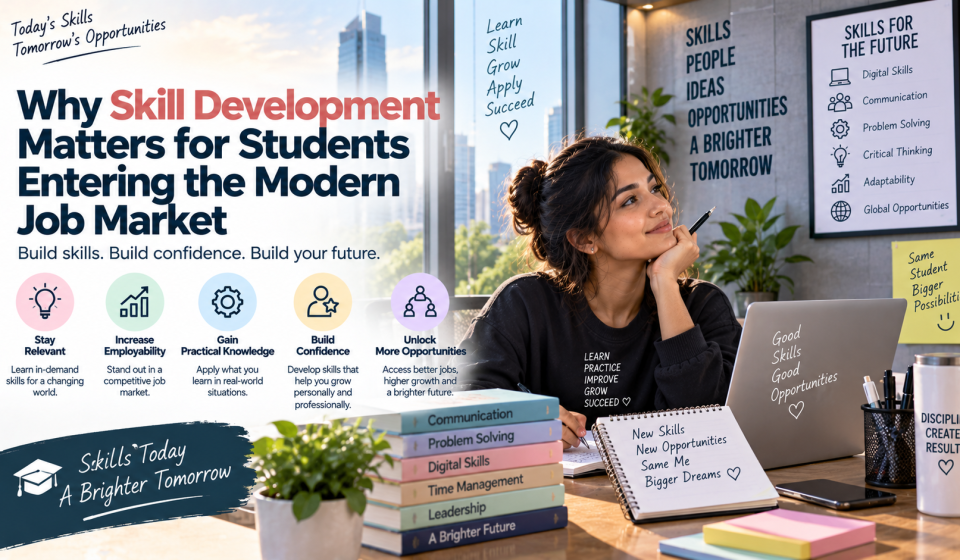

Discover why skill development matters for students entering the modern job market and how technical, communication, digital, and workplace skills can support career readiness.
Graduation can provide students with important academic knowledge, but entering the modern job market often requires more than a degree. Employers may also look for practical abilities, communication skills, digital confidence, problem-solving, teamwork, and the ability to learn continuously.
The workplace is changing as technology, business practices, and job responsibilities evolve. As a result, students can benefit from developing skills that help them apply what they have learned in real-world situations.
Skill development does not mean learning every possible skill. Instead, students should identify the abilities that are relevant to their career interests and gradually strengthen them through education, practice, projects, internships, and other practical experiences.
What Is Skill Development?
Skill development is the process of gaining, improving, and applying abilities that can support education, employment, and professional growth.
These skills may be technical, digital, interpersonal, analytical, creative, or organizational. The appropriate combination depends on the student’s chosen field.
For example, a software development student may need programming and database skills, while a student interested in marketing may need communication, research, content creation, and digital marketing skills.
Why a Degree Alone May Not Be Enough
A degree demonstrates academic study in a particular area, but employers may also want to know whether candidates can apply their knowledge.
A student may understand a programming concept but still need practical experience building a project. Similarly, a business student may understand management theories but benefit from experience working with a team or completing a real project.
Developing practical skills helps students connect classroom learning with workplace requirements.
Helps Students Become Career Ready
Career readiness involves preparing for the responsibilities of professional life. Skill development can help students become more comfortable with tasks they may encounter in entry-level positions.
Students who practice relevant skills before graduation may feel better prepared to participate in projects, communicate with colleagues, solve problems, and learn workplace processes.
Career readiness is not achieved through one course or certification. It develops through continuous learning and practical experience.
Technical Skills Are Important
Technical skills are abilities directly related to a particular profession or industry.
Depending on the field, these may include:
- Programming
- Data analysis
- Graphic design
- Accounting
- Digital marketing
- Database management
- Cybersecurity
- Research methods
- Project management
- Technical writing
- Industry-specific software
Students should research their target roles to understand which technical skills are commonly expected.
Focus on Relevant Skills
Students do not need to learn every technology or tool available. Trying to learn too many things at once can lead to shallow knowledge.
A better approach is to identify a career goal and focus on the skills most relevant to that direction. Students can then gradually expand their knowledge as they gain experience.
Digital Skills Are Increasingly Valuable
Digital tools are part of many modern workplaces. Even jobs that are not traditionally considered technical may require employees to use online platforms, productivity software, collaboration tools, data systems, or digital communication.
Students can benefit from developing basic digital confidence as well as field-specific technology skills.
Digital literacy also includes understanding how to use technology responsibly, evaluate online information, protect accounts and data, and communicate professionally online.
Communication Skills Matter
Technical knowledge alone may not be enough if a student cannot explain ideas clearly.
Communication skills include writing professional emails, presenting information, participating in discussions, listening carefully, asking questions, and explaining complex topics in understandable language.
These skills are useful in almost every workplace because employees regularly communicate with colleagues, managers, clients, customers, and other stakeholders.
Improve Written Communication
Students can practice writing through assignments, reports, project documentation, emails, resumes, and professional profiles.
Clear writing can make it easier for others to understand ideas and can contribute to a professional impression.
Improve Verbal Communication
Students can develop verbal communication by participating in presentations, group discussions, classroom activities, interviews, and professional events.
Practicing regularly can help students become more comfortable expressing their ideas.
Problem-Solving Skills Help Students Handle Challenges
Workplaces rarely operate without problems. Employees may need to identify causes, evaluate information, consider alternatives, and select practical solutions.
Students can develop problem-solving skills through projects, case studies, practical assignments, competitions, and real-world activities.
Instead of focusing only on getting the correct answer, students should practice understanding why a problem exists and how different solutions could affect the situation.
Critical Thinking Supports Better Decisions
Critical thinking involves evaluating information carefully rather than accepting every claim immediately.
Students can strengthen this skill by comparing sources, asking questions, examining evidence, identifying assumptions, and considering different perspectives.
These abilities can be useful when researching a topic, making workplace decisions, evaluating business information, or solving professional problems.
Teamwork Is an Essential Workplace Skill
Many jobs involve collaboration. Employees may work with people from different departments, backgrounds, and levels of experience.
Students can develop teamwork skills through group projects, student organizations, volunteering, internships, competitions, and other collaborative activities.
Effective teamwork involves listening, sharing responsibilities, respecting different viewpoints, meeting deadlines, and communicating when problems arise.
Adaptability Helps Students Respond to Change
Modern workplaces can change quickly. New technologies, processes, customer expectations, and business priorities may require employees to learn new approaches.
Students who develop adaptability may be better prepared to handle changes in their responsibilities.
Adaptability does not mean knowing everything. It means being willing to learn, accept feedback, adjust strategies, and develop new skills when circumstances change.
Time Management Supports Workplace Performance
Students often balance classes, assignments, examinations, projects, personal responsibilities, and extracurricular activities.
Learning to manage these responsibilities can prepare them for professional environments where employees may need to handle several deadlines.
Students can practice time management by creating realistic schedules, prioritizing important tasks, breaking large projects into smaller steps, and tracking deadlines.
Employers Value a Combination of Skills
Successful workplace performance often involves multiple skills working together.
For example, a web developer may need programming knowledge, problem-solving ability, communication skills, teamwork, time management, and an understanding of user needs.
Similarly, an accountant may need financial knowledge as well as analytical thinking, attention to detail, communication, digital skills, and organizational abilities.
This is why students should develop both technical and transferable skills.
Practical Experience Makes Skills More Meaningful
Reading about a skill is different from applying it. Practical experience allows students to test what they know and discover areas where they need improvement.
Students can gain experience through:
- Internships
- Academic projects
- Personal projects
- Volunteering
- Part-time work
- Student organizations
- Competitions
- Freelance activities where appropriate
- Workshops and practical training
Even small projects can provide opportunities to practice planning, execution, problem-solving, and communication.
Build a Portfolio
A portfolio can demonstrate practical abilities, particularly in fields where work samples are relevant.
Students in technology, design, writing, photography, marketing, data, and other project-based fields can use portfolios to present selected work.
A portfolio does not have to contain dozens of projects. A small number of well-developed projects can demonstrate how a student approaches problems and applies relevant skills.
Certifications Can Complement Learning
Professional certifications and online courses can sometimes support skill development, depending on the field and the quality of the program.
However, students should not collect certifications simply to make their resumes longer.
Before choosing a certification, students should consider whether it teaches relevant skills, is recognized within their target field, and complements their existing education and experience.
Practical application should remain an important part of learning.
Learn How to Use AI Responsibly
Artificial intelligence is becoming part of many educational and professional workflows. Students may encounter AI-powered tools for research, writing, coding, analysis, productivity, design, and other tasks.
Learning to use these tools responsibly can be useful, but students should also maintain their own understanding and judgment.
They should verify important information, protect confidential data, follow academic and workplace policies, and understand the limitations of AI-generated results.
The goal should be to use technology as a tool for productivity and learning rather than becoming completely dependent on it.
Build a Growth Mindset
Skill development is an ongoing process. Students may initially struggle with programming, public speaking, data analysis, writing, or another skill.
Making mistakes during practice is normal. Students can use feedback to identify weaknesses and improve gradually.
A growth-oriented approach encourages students to view skills as abilities that can be developed through learning, practice, and experience.
Networking Can Support Skill Development
Professional networking can expose students to new ideas and career opportunities. Conversations with professionals can help students understand which skills are actually used in their target industries.
Students can connect with professionals through career fairs, workshops, conferences, alumni networks, internships, academic events, and professional platforms.
Networking can also help students learn about workplace expectations that may not be obvious from textbooks.
Match Skills With Job Requirements
Students should regularly review real job descriptions for roles they are interested in.
They can identify skills that appear repeatedly and compare them with their current abilities. This can help students decide which areas deserve more attention.
For example, if several entry-level positions consistently mention a particular software tool, communication ability, or technical skill, students can investigate that requirement and determine whether developing it would be useful.
Develop Skills Before Graduation
Students should not wait until graduation to begin career preparation.
Starting early provides more time to experiment, make mistakes, complete projects, gain experience, and build confidence.
First-year students can focus on exploration, while later-year students can gradually develop specialized skills, practical experience, portfolios, and professional application materials.
Create a Personal Skill Development Plan
A simple skill development plan can help students stay organized.
Start by choosing a career direction. Then identify the skills commonly associated with relevant entry-level roles.
Divide the skills into three categories:
Already developed: Skills you can use confidently.
Currently developing: Skills you understand but need more practice with.
Need to learn: Skills that are important but unfamiliar.
Students can then set realistic learning goals and review their progress regularly.
Avoid Trying to Learn Everything
The modern job market contains an enormous number of technologies, tools, courses, and professional skills. Trying to learn all of them is unrealistic.
Students should focus on depth before constantly moving to another topic. Strong foundational knowledge can make it easier to learn advanced tools later.
A focused skill set that matches a career goal is generally more useful than a long list of unrelated skills.
Keep Learning After Getting a Job
Skill development should continue after graduation. Professional responsibilities can introduce new challenges and learning opportunities.
Employees may need to learn new software, processes, regulations, technologies, communication methods, or industry practices throughout their careers.
Students who develop the habit of continuous learning early can carry that approach into professional life.
Sources
- https://www.ilo.org/topics/skills-and-lifelong-learning
- https://www.oecd.org/en/topics/skills.html
- https://www.naceweb.org/career-readiness/competencies/career-readiness-defined/
- https://www.weforum.org/publications/the-future-of-jobs-report-2025/
- https://www.bls.gov/ooh/
Conclusion
Skill development matters because students entering the modern job market need to demonstrate more than academic knowledge. Technical abilities, digital literacy, communication, problem-solving, critical thinking, teamwork, adaptability, and time management can all contribute to career readiness.
Students can begin developing these abilities through practical projects, internships, courses, volunteering, teamwork, certifications where appropriate, and regular practice. They should focus on skills that match their career interests rather than trying to learn everything at once.
Ultimately, skill development is a continuous process. By starting early, gaining practical experience, responding to feedback, and remaining willing to learn, students can build a stronger foundation for their professional journey.
FAQs
1. Why is skill development important for students?
Skill development helps students apply academic knowledge, prepare for workplace responsibilities, demonstrate practical abilities, and respond to changing professional requirements.
2. What skills should students develop before entering the job market?
Students can develop technical skills related to their chosen field along with communication, teamwork, problem-solving, critical thinking, digital literacy, adaptability, and time management.
3. Are technical skills more important than soft skills?
Both are valuable. Technical skills provide field-specific abilities, while soft and transferable skills help students communicate, collaborate, solve problems, and work effectively.
4. How can students develop practical skills?
Students can develop practical skills through internships, academic projects, personal projects, volunteering, workshops, competitions, part-time experiences, and hands-on courses.
5. Can certifications help students get jobs?
Relevant certifications can complement education and demonstrate focused learning, but their value depends on the career, certification, and employer. Practical skills and experience can also be important.
6. How can students identify which skills they need?
Students can research current job descriptions for their target roles and identify skills that employers commonly request. They can then compare those requirements with their current abilities.
7. Why are communication skills important in the workplace?
Communication helps employees explain ideas, write clearly, listen to others, participate in discussions, collaborate with teams, and interact professionally with clients or colleagues.
8. Should students learn AI tools?
Students may benefit from learning relevant AI tools while also developing independent knowledge and judgment. They should use AI responsibly, verify important information, protect sensitive data, and follow applicable academic or workplace rules.
9. When should students start developing career skills?
Students can start at any stage of education. Beginning early gives them more time to explore interests, practice skills, complete projects, gain experience, and understand workplace expectations.
10. Is skill development useful after getting a job?
Yes. Professional roles can change over time, so continuous learning can help employees adapt to new technologies, responsibilities, processes, and industry developments.