
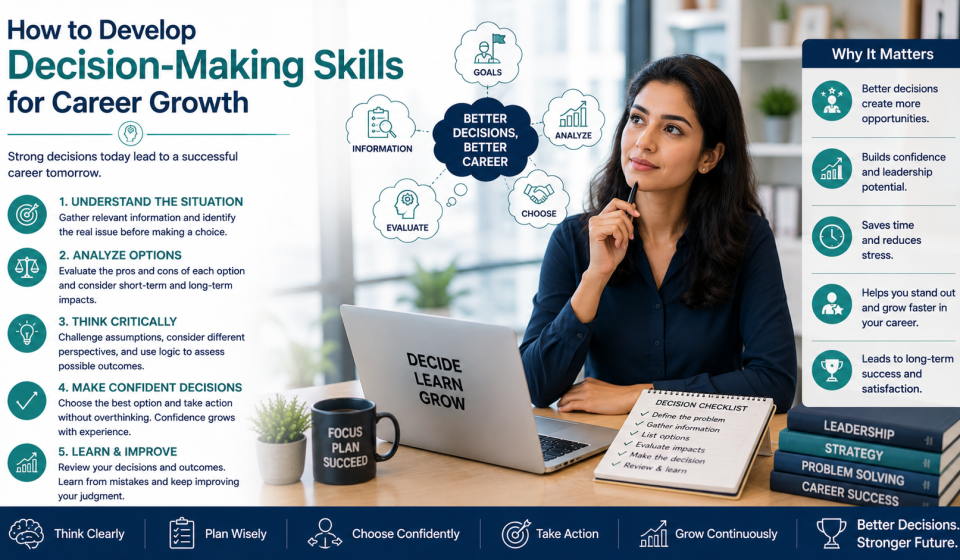

Learn how to develop decision-making skills for career growth. Discover practical strategies, problem-solving techniques, and habits that help you make confident career decisions and achieve long-term professional success.
Decision-making is one of the most valuable skills in today’s professional world. Every career involves making choices, from selecting the right job and managing daily tasks to solving workplace challenges and planning long-term goals. Strong decision-making skills help professionals act confidently, minimize risks, and create better opportunities for career advancement. Whether you are a student, a recent graduate, or an experienced employee, improving this skill can have a significant impact on your professional journey.
Career growth depends on making informed and thoughtful decisions rather than acting on impulse. Successful professionals evaluate situations carefully, gather relevant information, and consider the potential outcomes before choosing a course of action. By developing effective decision-making skills, you can improve your confidence, increase productivity, strengthen leadership abilities, and achieve your career goals more efficiently.
Understanding Decision-Making Skills
Decision-making is the process of evaluating different options and selecting the most appropriate solution for a particular situation. In the workplace, professionals make decisions related to problem-solving, teamwork, project management, communication, and career planning.
Good decision-making involves:
- Identifying the problem
- Gathering accurate information
- Evaluating possible solutions
- Considering risks and benefits
- Choosing the best option
- Reviewing the results
Developing these abilities helps professionals handle workplace challenges with greater confidence.
Why Decision-Making Skills Are Important for Career Growth
Strong decision-making skills contribute to long-term career success by helping professionals solve problems efficiently and make informed choices. Employers value individuals who can think critically, analyze situations, and take responsibility for their decisions.
Benefits of effective decision-making include:
- Increased confidence
- Better problem-solving abilities
- Improved productivity
- Stronger leadership potential
- Higher workplace efficiency
- Greater career advancement opportunities
Professionals who make sound decisions are often trusted with greater responsibilities and leadership roles.
Set Clear Career Goals
Clear goals provide direction and make decision-making easier. Knowing what you want to achieve allows you to evaluate opportunities based on your long-term objectives.
When setting career goals:
- Define short-term goals
- Create long-term objectives
- Monitor your progress
- Adjust goals when necessary
- Stay focused on continuous improvement
Well-defined goals help eliminate confusion and support better career decisions.
Gather Relevant Information
Making decisions without enough information can lead to unnecessary mistakes. Before choosing a solution or accepting a new opportunity, collect accurate and reliable information.
You can gather information by:
- Researching industry trends
- Seeking expert advice
- Reading professional resources
- Consulting experienced colleagues
- Reviewing company policies
The more informed you are, the more confident your decisions will be.
Strengthen Critical Thinking Skills
Critical thinking helps professionals evaluate situations objectively rather than relying on assumptions or emotions. It encourages logical analysis and thoughtful decision-making.
Ways to improve critical thinking include:
- Asking meaningful questions
- Analyzing facts carefully
- Comparing different perspectives
- Challenging assumptions
- Evaluating evidence before deciding
Critical thinking supports smarter workplace decisions and better problem-solving.
Learn to Solve Problems Systematically
Every workplace presents challenges that require effective solutions. Developing a structured problem-solving approach makes decision-making more efficient.
A simple process includes:
- Identify the problem.
- Understand its cause.
- List possible solutions.
- Compare the advantages and disadvantages.
- Select the best option.
- Review the outcome and learn from the experience.
Following a clear process reduces uncertainty and improves confidence.
Improve Time Management
Poor time management often leads to rushed decisions. Organizing your workload gives you enough time to evaluate options carefully.
Helpful strategies include:
- Prioritizing important tasks
- Using daily planners
- Setting realistic deadlines
- Avoiding procrastination
- Breaking large projects into smaller tasks
Better time management allows for more thoughtful and informed decisions.
Build Emotional Intelligence
Emotional intelligence plays an important role in decision-making because emotions can influence judgment. Professionals with strong emotional intelligence remain calm under pressure and communicate effectively.
Develop emotional intelligence by:
- Practicing self-awareness
- Managing stress effectively
- Listening actively
- Showing empathy
- Maintaining professional relationships
Balanced emotions contribute to wiser workplace decisions.
Learn from Experience
Experience is one of the best teachers. Every decision, whether successful or unsuccessful, provides valuable lessons for future situations.
After making a decision, ask yourself:
- What worked well?
- What challenges occurred?
- What could be improved?
- What lessons can I apply next time?
Continuous reflection helps improve future decision-making skills.
Be Open to Feedback
Constructive feedback helps identify strengths and areas for improvement. Seeking advice from managers, mentors, or colleagues can improve your decision-making process.
Feedback helps you:
- Recognize blind spots
- Improve judgment
- Gain new perspectives
- Build professional confidence
Listening to experienced professionals can lead to better career choices.
Develop Confidence
Confidence allows professionals to make decisions without unnecessary hesitation. Confidence grows through preparation, knowledge, and experience.
Ways to build confidence include:
- Expanding your knowledge
- Practicing decision-making regularly
- Accepting responsibility
- Learning from mistakes
- Celebrating small achievements
Confident professionals inspire trust and are often considered for leadership opportunities.
Improve Communication Skills
Good communication supports effective decision-making by ensuring everyone understands expectations, goals, and responsibilities.
Strong communication includes:
- Active listening
- Clear explanations
- Asking relevant questions
- Respectful discussions
- Sharing ideas confidently
Better communication reduces misunderstandings and improves teamwork.
Stay Adaptable
Workplaces continue to evolve with new technologies, market trends, and business challenges. Adaptability helps professionals make better decisions in changing situations.
Adaptable professionals:
- Embrace change
- Learn new skills
- Stay informed
- Adjust strategies when needed
- Remain open to innovation
Flexibility strengthens long-term career growth.
Source Links
- https://www.mindtools.com
- https://www.coursera.org
- https://hbr.org
- https://www.indeed.com/career-advice
Conclusion
Developing strong decision-making skills is essential for achieving long-term career growth and professional success. By setting clear goals, gathering accurate information, strengthening critical thinking, improving communication, and learning from experience, professionals can make confident choices that support their careers. Effective decision-making not only improves job performance but also builds leadership potential and earns the trust of employers and colleagues.
Career success is rarely the result of a single decision. It comes from consistently making thoughtful, informed choices that align with your goals and values. By practicing these strategies regularly, you can become a more confident professional, overcome workplace challenges, and create new opportunities for personal and career development.
Frequently Asked Questions (FAQs)
1. What are decision-making skills?
Decision-making skills are the ability to evaluate options, solve problems, and choose the most effective course of action.
2. Why are decision-making skills important for career growth?
They help professionals solve workplace challenges, improve productivity, build leadership qualities, and advance in their careers.
3. How can I improve my decision-making skills?
You can improve by setting goals, gathering information, practicing critical thinking, learning from experience, and seeking feedback.
4. What role does critical thinking play in decision-making?
Critical thinking helps you analyze facts objectively, compare options, and make informed decisions.
5. Can decision-making skills be learned?
Yes. Regular practice, education, feedback, and real-life experience can significantly improve decision-making abilities.
6. How does emotional intelligence affect decision-making?
Emotional intelligence helps manage emotions, reduce stress, and improve communication, leading to better decisions.
7. Why is gathering information important before making decisions?
Accurate information reduces uncertainty, improves confidence, and increases the chances of making successful decisions.
8. How can feedback improve decision-making?
Feedback provides new perspectives, identifies mistakes, and helps professionals refine their judgment.
9. What are common mistakes in decision-making?
Common mistakes include acting too quickly, ignoring facts, relying only on emotions, and failing to consider long-term consequences.
10. How do decision-making skills support leadership?
Leaders make important decisions daily. Strong decision-making skills help them solve problems, guide teams, manage risks, and achieve organizational goals.


