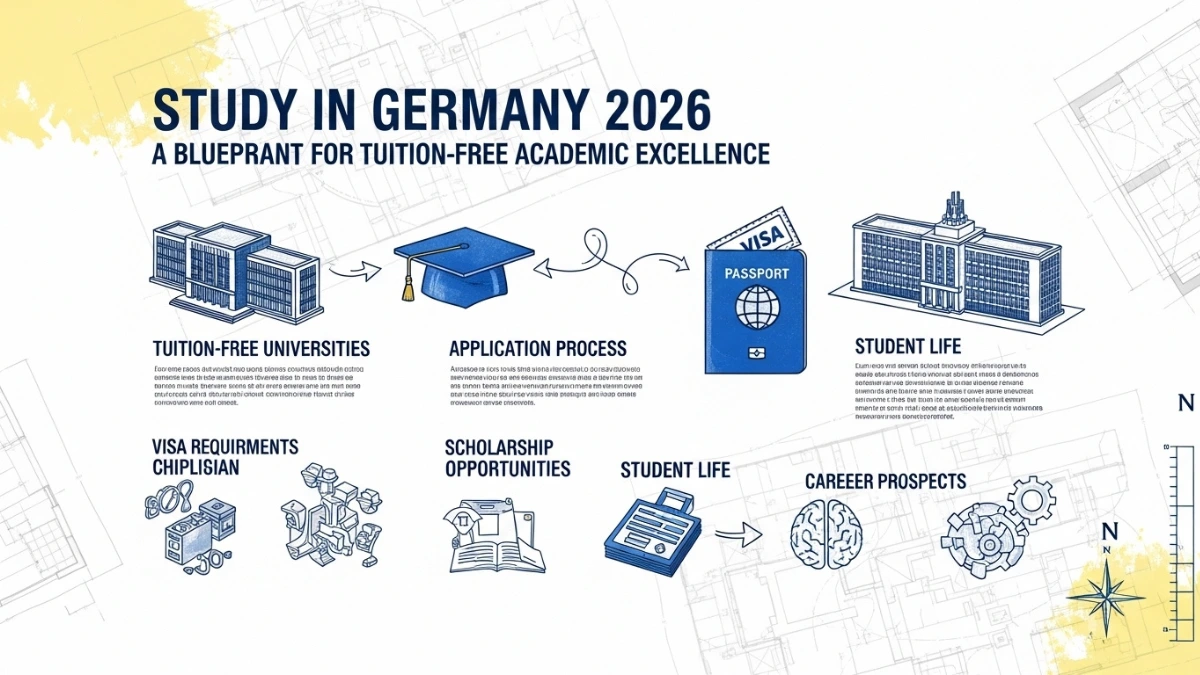

For international students in 2026, Germany remains the global leader in high-quality, tuition-free education. This 1450-word guide provides a comprehensive strategic roadmap for studying in Germany in 2026, exploring the technical prowess of German universities and the path to a global career in the heart of Europe.
Germany has long been the powerhouse of European innovation. In 2026, the “German Degree” represents the ultimate combination of theoretical depth and practical Digital Skills. For the 2026 aspirant, Germany offers a unique proposition: world-class education with no tuition fees at public universities. This makes it the cornerstone of any efficient 2026 Education Investment Plan. As Germany faces a demographic need for high-skilled talent, the 2026 international student is seen as a vital part of the nation’s future, particularly in Engineering, Green Technology, and Applied Sciences.
Introduction
The year 2026 marks a period of significant growth for Germany’s international academic programs. With an increasing number of Master’s courses being taught entirely in English, Germany has become more accessible to global talent than ever before. However, the 2026 landscape requires more than just high grades; it requires a “Professional Mindset.” German institutions look for students who are ready to integrate into the 2026 workforce, mastering not only their subjects but also the 2026 Digital Skills required by German industry leaders. This guide will walk you through the nuances of the 2026 APS certificate, the importance of the Blocked Account, and the strategic benefits of the 18-month Job Seeker Visa. Whether you are aiming for a TU9 technical university or a specialized University of Applied Sciences, this is your 2026 German blueprint.
The 2026 German Academic Map: TU9 Prestige vs. Applied Sciences
In 2026, the “TU9” group of technical universities—including schools in Munich, Berlin, and Aachen—continues to lead the world in Mechanical and Automotive Engineering. These are the primary targets for 2026 students seeking PhD Scholarships and research roles at the cutting edge of sustainability. However, the 2026 trend also favors “Fachhochschulen” (Universities of Applied Sciences), which offer hands-on training that is directly tied to the immediate needs of 2026 German Mittelstand (small and medium enterprises).
Strategic City Selection in 2026 Germany
While Berlin and Munich are the most famous 2026 hubs, many students are finding incredible 2026 value in cities like Stuttgart, Hamburg, and Leipzig. These cities are the centers of specific 2026 industrial clusters—Stuttgart for Automotive, Hamburg for Logistics, and Leipzig for E-commerce. Studying in these 2026 regional centers often leads to faster Career Growth, as you are located in the heart of the job market for your specific 2026 niche.
Navigating the 2026 German Visa Landscape: APS and Blocked Account
Securing a German Student Visa in 2026 requires meticulous planning. For students from many countries, the “APS Certificate” (Academic Evaluation Centre) is the first and most critical step. This document verifies your academic credentials and is mandatory for 2026 university admissions and visa processing. In 2026, the APS system ensures the highest level of academic integrity, making early 2026 application vital.
The 2026 Blocked Account Requirement
To prove your financial stability in 2026, you must set up a “Blocked Account” (Sperrkonto). For 2026, the required amount has been updated to approximately €11,200 to €12,000 per year. This ensures you have enough funds to cover the 2026 German cost of living. Many 2026 families use specialized Student Loan Options to fund this account, providing a secure 2026 Education Investment Plan without liquidating local assets.
Mastering the 2026 German Admission Process
Admissions in 2026 for German universities are “Criteria-Based.” Most public universities do not use interviews; instead, they focus on your 2026 ECTS credits and academic relevance. Your Statement of Purpose (SOP) must demonstrate a “Research Interest” that aligns with the specific 2026 strengths of the department. In 2026, show that you have mastered the Digital Skills necessary for modern laboratory work or data analysis.
Language Proficiency: IELTS and German basics
While many 2026 Master’s degrees are in English, the 2026 Job Market requires German at the B1 or B2 level. Having an IELTS score of 6.5+ and a basic A1/A2 German certificate in 2026 significantly increases your chances of both 2026 admission and securing the various Study Abroad Scholarships offered by foundations like DAAD in 2026.
The 18-Month Job Seeker Visa: The 2026 German Dream
After graduating in 2026, you are entitled to an 18-month stay-back permit to find a job related to your degree. This is one of the most generous 2026 policies in the world. In 2026, the German government has simplified the “EU Blue Card” and “Chancenkarte” (Opportunity Card) processes for international graduates, making Career Growth and Permanent Residency (PR) in Germany a very realistic 2026 goal. Your 2026 Digital Skills will be your greatest asset in this high-tech 2026 economy.
Part-Time Work and 2026 Student Life
In 2026, international students in Germany can work up to 140 full days per year. This is a great way to cover your 2026 living costs and gain “Werkstudent” (Working Student) experience, which is the most effective way to launch your 2026 professional career in Europe.
Cost of Living and Public Services in 2026 Germany
Life in 2026 Germany is characterized by efficiency and high-quality public services. Your “Semester Contribution” fee (usually €200-€400 in 2026) covers your public transport and administrative costs. In 2026, Germany also offers mandatory but affordable “Student Health Insurance,” ensuring that your 2026 academic focus is nunca interrupted by medical emergencies.
FAQ
Are German public universities really tuition-free in 2026?
Yes. In 2026, almost all public universities in Germany charge zero tuition for international students, with very few regional exceptions (like Baden-Württemberg).
Do I need to speak German to study in 2026?
No for your studies if the course is English-taught, but Yes for your 2026 Career Growth and social integration.
What is the APS certificate in 2026?
The APS in 2026 is a mandatory verification of your academic documents for students from countries like India, China, and Vietnam.
How long does it take to get a 2026 German Student Visa?
In 2026, visa processing usually takes 4 to 8 weeks after your interview at the German embassy.
Conclusion
Choosing to study in Germany in 2026 is a move of intense strategic wisdom. it is a path towards a world-class, tuition-free education in the heart of Europe’s most powerful economy. By leveraging the 2026 18-month job seeker visa, selecting a high-growth industrial hub, and focusing on high-value Digital Skills, you are building a professional foundation of immense value. Germany 2026 is a place where your 2026 talent meets opportunity. The “German Eagle” represents a promise of precision, quality, and global impact. Start your 2026 German journey today—master the language, secure your Blocked Account, and prepare for an academic adventure that will define your 2026 legacy. The heart of Europe is waiting for you in 2026. Come and be a part of the 2026 innovation story.