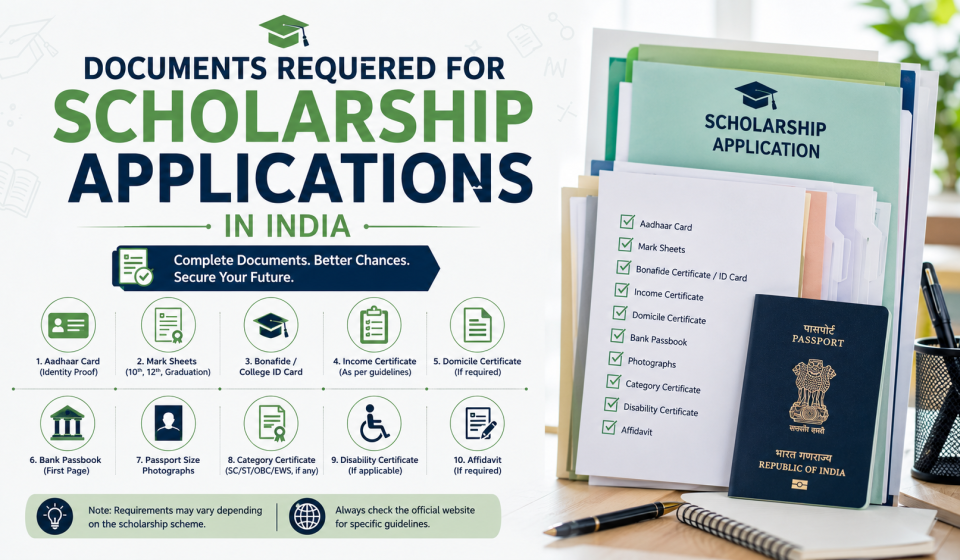

Learn about the documents required for scholarship applications in India. Discover the essential certificates, income proof, academic records, and tips to prepare a successful scholarship application.
Scholarships play a significant role in helping students achieve their educational goals by reducing financial burdens. In India, government departments, private organisations, educational institutions, and charitable trusts offer scholarships to support deserving students based on merit, financial need, or specific eligibility criteria.
One of the most important steps in the scholarship application process is submitting the correct documents. Missing or incorrect paperwork can delay the application or even lead to rejection. Understanding the documents required before applying helps students complete the process smoothly and improves their chances of receiving financial assistance.
This guide explains the common documents required for scholarship applications in India, why they are important, and how students can prepare them in advance.
Why Documents Are Important for Scholarship Applications
Scholarship providers use documents to verify a student’s identity, academic performance, financial background, and eligibility. Proper documentation ensures that scholarships are awarded fairly and only to eligible candidates.
Submitting accurate and complete documents also speeds up the verification process and reduces the chances of application errors.
Benefits of preparing documents in advance include:
- Faster application submission
- Fewer mistakes during registration
- Quicker verification
- Reduced risk of rejection
- Better organisation of important records
Identity Proof
Every scholarship application requires proof of identity to verify the applicant’s personal details.
Common identity documents include:
- Aadhaar Card
- PAN Card (if applicable)
- Voter ID (for eligible applicants)
- Passport
- Driving Licence (where accepted)
Applicants should ensure that their name and date of birth match across all documents.
Aadhaar Card
The Aadhaar Card is one of the most commonly requested documents for scholarship applications in India. Many scholarship portals use Aadhaar for identity verification and linking applicant information.
Students should ensure that:
- Aadhaar details are accurate.
- Mobile number is linked with Aadhaar.
- Personal details match educational records.
Academic Certificates and Mark Sheets
Scholarship providers usually require proof of academic performance.
Common academic documents include:
- Previous year’s mark sheet
- Board examination certificates
- Semester result sheets
- Degree certificates (where applicable)
- School leaving certificate
Students should upload clear and readable copies of all academic records.
Income Certificate
Many scholarships are awarded based on family income. An income certificate issued by the competent authority is often mandatory.
The certificate generally includes:
- Annual family income
- Parent or guardian details
- Issuing authority information
Applicants should ensure the certificate is valid according to the scholarship guidelines.
Caste Certificate (If Applicable)
Students applying under reserved categories may need to provide a caste certificate.
Common categories include:
- Scheduled Caste (SC)
- Scheduled Tribe (ST)
- Other Backward Classes (OBC)
- Economically Weaker Section (EWS), where applicable
The certificate should be issued by the appropriate government authority.
Domicile Certificate
Some state-level scholarships are available only to permanent residents of a particular state.
A domicile certificate confirms the applicant’s state of residence and may be required for eligibility verification.
Bonafide Certificate
A bonafide certificate confirms that the applicant is currently enrolled in a recognised educational institution.
It generally includes:
- Student’s name
- Course name
- Institution name
- Academic year
- Official signature and seal
Admission Letter or Fee Receipt
Many scholarship programmes ask for proof of admission or fee payment.
Acceptable documents may include:
- Admission confirmation letter
- College fee receipt
- Tuition fee payment receipt
- Enrolment confirmation
These documents verify that the student is pursuing the stated course.
Bank Account Details
Scholarship amounts are generally transferred directly into the student’s bank account through Direct Benefit Transfer (DBT).
Applicants may need:
- Bank passbook copy
- Cancelled cheque (if requested)
- Bank account number
- IFSC code
The bank account should preferably be in the student’s name, if required by the scholarship guidelines.
Passport-Size Photograph
Most scholarship applications require a recent passport-size photograph.
The photograph should:
- Be clear and recent
- Meet the specified size requirements
- Have a plain background if requested
Signature
Applicants may need to upload a scanned signature.
Ensure that:
- The signature is clear.
- It matches official records where required.
- The file meets the prescribed format and size.
Disability Certificate (If Applicable)
Students applying under disability scholarship schemes may need a valid disability certificate issued by an authorised medical board.
The certificate should clearly mention:
- Type of disability
- Percentage of disability
- Issuing authority
Other Supporting Documents
Depending on the scholarship scheme, additional documents may include:
- Gap certificate
- Migration certificate
- Character certificate
- Recommendation letter
- Internship certificate
- Sports achievement certificates
- NCC or NSS certificates
- Research proposal (for higher education scholarships)
Always check the scholarship guidelines for specific requirements.
Tips for Preparing Scholarship Documents
Proper preparation can make the application process much easier.
Helpful tips include:
- Keep scanned copies ready in PDF and image formats.
- Ensure documents are clear and readable.
- Check expiry dates on certificates.
- Use the correct file size and format.
- Match names across all documents.
- Keep both digital and printed copies.
- Read scholarship instructions carefully before uploading.
Common Mistakes to Avoid
Many applications are rejected because of avoidable errors.
Avoid these mistakes:
- Uploading blurred documents
- Providing incorrect information
- Using expired certificates
- Missing mandatory documents
- Incorrect bank account details
- Applying after the deadline
- Ignoring file size requirements
Carefully reviewing the application before submission can help prevent these issues.
Sources
- https://scholarships.gov.in
- https://www.ugc.gov.in
- https://www.aicte-india.org
- https://www.education.gov.in
Conclusion
Preparing the correct documents is one of the most important steps when applying for scholarships in India. Identity proof, academic records, income certificates, bank details, and other supporting documents help scholarship providers verify eligibility and process applications efficiently.
Students should carefully read the official guidelines for each scholarship scheme, as document requirements may vary. Keeping all documents organised, updated, and ready before applications open can save time and improve the chances of a successful application.
With careful preparation and accurate documentation, students can complete scholarship applications confidently and focus on achieving their educational goals.
Frequently Asked Questions (FAQs)
1. Which document is mandatory for most scholarship applications in India?
Most scholarship applications require an Aadhaar Card, academic mark sheets, an income certificate, bank account details, and a recent passport-size photograph. Additional documents depend on the specific scholarship.
2. Is an income certificate compulsory for every scholarship?
No. Income certificates are generally required for need-based scholarships. Merit-based scholarships may not always ask for income proof, so applicants should check the official guidelines.
3. Can I apply without an Aadhaar Card?
Some scholarships require Aadhaar for verification, while others may accept alternative identity documents. Always refer to the scholarship’s eligibility requirements.
4. Why are bank account details required?
Scholarship funds are usually transferred directly to the student’s bank account through Direct Benefit Transfer (DBT), making accurate banking information essential.
5. What file format should scanned documents be uploaded in?
Most scholarship portals accept PDF, JPG, JPEG, or PNG files. Applicants should follow the file size and format instructions provided in the application guidelines.
6. Can I use self-attested copies of documents?
Some scholarship providers accept self-attested documents, while others require originals or documents verified by authorised officials. Check the scholarship instructions before submitting.
7. What happens if I upload incorrect documents?
Uploading incorrect or incomplete documents may delay verification or result in the rejection of the scholarship application. Always review the application carefully before submission.
8. Where can students find official scholarship information?
Students can visit the National Scholarship Portal, the Ministry of Education website, state scholarship portals, or their educational institution’s official website for authentic information.