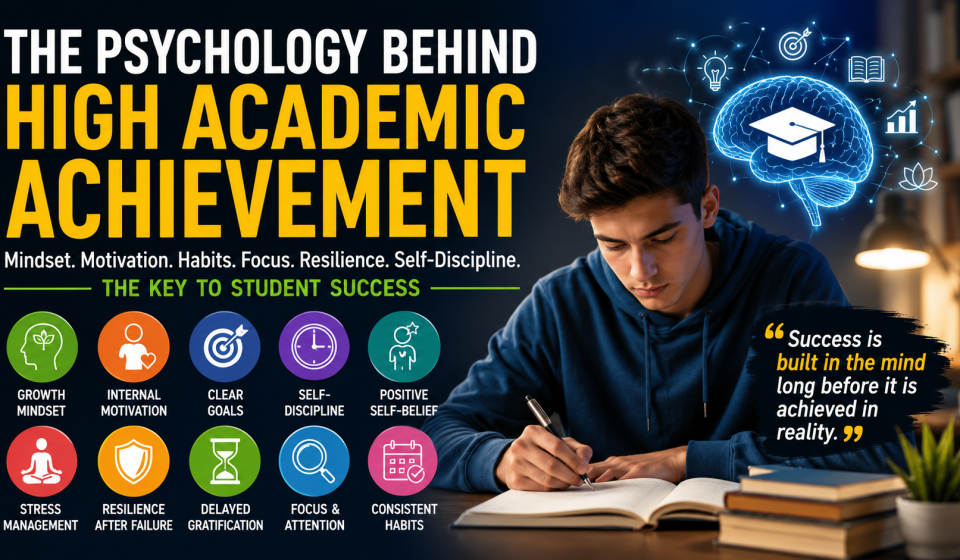

Discover the psychology behind high academic achievement. Learn how mindset, motivation, habits, focus, resilience, and self-discipline contribute to student success and academic excellence.
Why do some students consistently perform at a high level while others struggle despite putting in similar effort? The answer often lies not in intelligence but in psychology. High academic achievers share certain mental habits, attitudes, and behaviors that help them stay motivated, focused, and resilient throughout their educational journey.
Understanding the psychology behind academic success can help students develop the mindset and habits needed to achieve their full potential.
What Is High Academic Achievement?
High academic achievement refers to consistently strong performance in learning, examinations, assignments, and overall educational development.
It involves:
- Strong study habits
- Effective learning strategies
- Positive mindset
- Consistent effort
- Goal-oriented behavior
Academic success is often the result of psychological factors working together over time.
The Myth of Natural Intelligence
Many people believe that top students succeed because they are naturally gifted.
Research suggests that factors such as:
- Persistence
- Discipline
- Motivation
- Learning habits
- Mindset
often play a bigger role than raw intelligence alone.
Successful students focus on continuous improvement rather than relying solely on talent.
1. Growth Mindset
One of the most important psychological traits of high achievers is a growth mindset.
Students with a growth mindset believe:
- Intelligence can improve
- Skills can be developed
- Mistakes are learning opportunities
- Effort leads to progress
Benefits:
- Greater resilience
- Higher motivation
- Improved academic performance
2. Strong Internal Motivation
High achievers are often driven by internal motivation.
They study because they:
- Enjoy learning
- Want to improve themselves
- Have meaningful goals
- Value education
Internal motivation tends to be more sustainable than external rewards alone.
3. Clear Goal Setting
Successful students set specific academic goals.
Examples:
- Improve grades
- Complete certifications
- Master difficult subjects
- Develop new skills
Goals provide direction and increase commitment.
4. Self-Discipline Over Motivation
Motivation changes from day to day.
Self-discipline ensures students continue working even when motivation decreases.
Disciplined students:
- Follow study schedules
- Complete tasks consistently
- Avoid procrastination
Discipline often predicts success better than temporary motivation.
5. Positive Self-Belief
Students who believe they can succeed are more likely to take action.
Benefits of positive self-belief:
- Greater confidence
- Better performance
- Increased persistence
- Reduced fear of failure
Confidence grows through preparation and experience.
6. Effective Stress Management
Moderate stress can improve performance, but excessive stress can harm learning.
High achievers manage stress through:
- Exercise
- Time management
- Healthy routines
- Mindfulness
Managing stress helps maintain focus and productivity.
7. Resilience After Failure
Failure is part of learning.
Successful students:
- Learn from mistakes
- Analyze weaknesses
- Adjust strategies
- Continue moving forward
Resilience helps students recover quickly from setbacks.
8. Delayed Gratification
High academic achievers often prioritize long-term goals over immediate pleasures.
Examples:
- Studying before entertainment
- Completing assignments before gaming
- Preparing early for exams
Delayed gratification is strongly associated with academic success.
9. Strong Focus and Attention
Focused students learn more efficiently.
Strategies include:
- Eliminating distractions
- Using study schedules
- Following the Pomodoro Technique
- Creating productive study environments
Attention is one of the most valuable learning resources.
10. Consistent Learning Habits
Psychology research shows that habits shape behavior.
Successful students often:
- Study daily
- Revise regularly
- Review goals
- Practice active learning
Consistency creates long-term success.
The Role of Emotional Intelligence
Emotional intelligence helps students:
- Manage emotions
- Handle pressure
- Build relationships
- Communicate effectively
Students with strong emotional intelligence often perform better academically and socially.
How High Achievers Think Differently
Top-performing students often:
- Focus on solutions rather than problems
- View challenges as opportunities
- Take responsibility for results
- Seek continuous improvement
Their mindset influences their actions and outcomes.
Psychological Study Techniques That Improve Performance
Active Recall
Retrieving information from memory strengthens learning.
Spaced Repetition
Reviewing information over time improves retention.
Self-Testing
Frequent testing improves confidence and recall.
Visualization
Imagining success can improve motivation and focus.
These techniques align with how the brain naturally learns.
Common Psychological Barriers to Success
Students often struggle because of:
- Fear of failure
- Negative self-talk
- Perfectionism
- Lack of confidence
- Procrastination
Overcoming these barriers is essential for academic growth.
How Students Can Develop a High-Achiever Mindset
Practical steps include:
- Setting meaningful goals
- Practicing self-discipline
- Maintaining positive habits
- Learning from mistakes
- Developing resilience
- Managing stress effectively
Small changes in mindset can produce significant improvements over time.
Benefits of Understanding Academic Psychology
Students who understand the psychology of achievement often experience:
- Better grades
- Improved confidence
- Higher motivation
- Stronger resilience
- Better focus
- Greater long-term success
Understanding how the mind works helps students learn more effectively.
Sources
- American Psychological Association
- Harvard Learning Center
- Khan Academy
- Coursera
- edX
- Google for Education
- MIT OpenCourseWare
Conclusion
High academic achievement is not solely the result of intelligence. It is strongly influenced by mindset, motivation, discipline, resilience, and consistent habits. Students who develop a growth mindset, manage stress effectively, embrace challenges, and maintain disciplined study routines are more likely to achieve their academic goals. By understanding the psychology behind success, students can unlock their full potential and build a strong foundation for lifelong learning and achievement.
Frequently Asked Questions (FAQs)
What is high academic achievement?
High academic achievement refers to consistently strong performance in learning, exams, assignments, and educational development.
Is intelligence the main factor behind academic success?
No. Mindset, discipline, motivation, habits, and resilience often play equally important or greater roles.
What is a growth mindset?
A growth mindset is the belief that abilities and intelligence can improve through effort and learning.
Why is self-discipline important for students?
Self-discipline helps students stay consistent, avoid procrastination, and achieve long-term goals.
How does motivation affect academic performance?
Motivation encourages effort, persistence, and engagement in learning activities.
What role does resilience play in success?
Resilience helps students recover from setbacks and continue progressing toward their goals.
Can stress affect academic achievement?
Yes. Excessive stress can reduce focus and performance, while effective stress management supports success.
What are the habits of high-achieving students?
They study consistently, manage time well, set goals, revise regularly, and maintain positive routines.
How can students improve confidence?
Preparation, practice, goal achievement, and positive self-belief help build confidence.
What is the most important psychological trait for academic success?
A growth mindset combined with self-discipline is often considered one of the strongest predictors of academic achievement.