
Discover why digital credentials matter in modern education and how certificates, badges, and verified achievements can support learning, skills, and career opportunities.
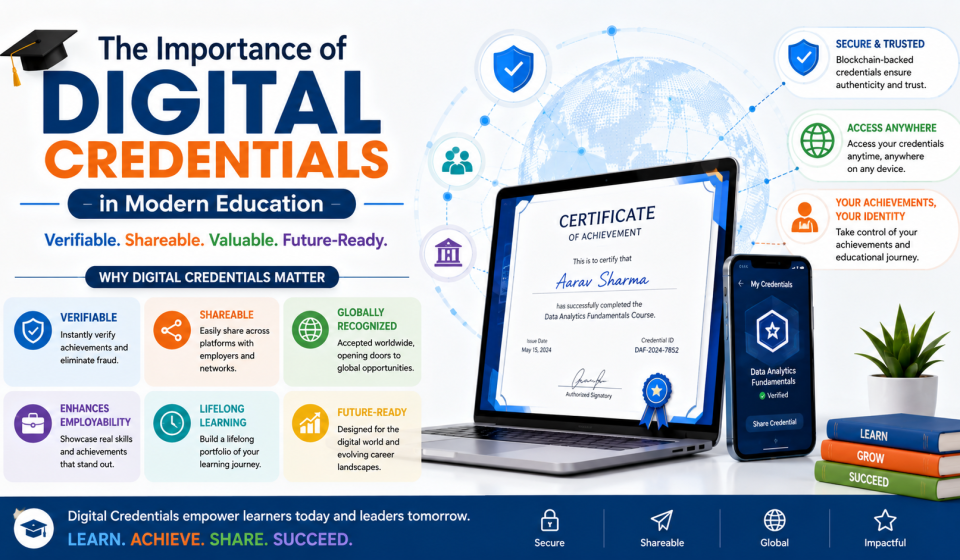
Digital credentials are becoming an increasingly important part of modern education as learning continues to expand beyond traditional classrooms. Online courses, professional training, university programs, workshops, and skill-based learning can now provide learners with digital certificates, badges, and other forms of verified achievement. These credentials can help students demonstrate what they have learned and communicate their skills to educational institutions and employers.
For students and professionals, digital credentials can provide a convenient way to document learning and build a professional profile. When issued by credible institutions and supported by verifiable information, they can complement traditional qualifications and provide additional evidence of specific skills, knowledge, or achievements.
What Are Digital Credentials?
Digital credentials are electronic records that represent a learner’s achievement, qualification, skill, or participation in an educational or professional activity.
They can include:
- Digital certificates.
- Digital badges.
- Micro-credentials.
- Course completion certificates.
- Professional certifications.
- Skill-based credentials.
- Verified academic achievements.
A digital credential may contain information about the issuing organization, the learner, the achievement, the date it was awarded, and sometimes the criteria required to earn it.
Why Digital Credentials Are Growing in Education
Education has become increasingly flexible and technology-driven. Students can learn through universities, online platforms, professional organizations, training providers, and independent educational programs.
This creates a need for ways to document different types of learning. Digital credentials can provide a standardized and shareable way to show that a learner completed a particular educational activity or demonstrated specific knowledge and skills.
They can be particularly useful when traditional degrees do not fully describe a person’s complete range of abilities.
Digital Credentials Support Lifelong Learning
Learning does not stop after graduation. Professionals often need to develop new skills as industries, technologies, and workplace requirements change.
Digital credentials can help learners document short courses, specialized training, and continuing education throughout their careers.
For example, someone with a business degree might later complete credentials in:
- Data analysis.
- Digital marketing.
- Project management.
- Artificial intelligence.
- Cybersecurity.
- Leadership.
- Communication.
These additional achievements can demonstrate an ongoing commitment to professional development.
Digital Credentials Provide Evidence of Specific Skills
A traditional degree can demonstrate broad educational achievement, but it may not show every specific skill a learner has developed.
Digital credentials can focus on particular areas of knowledge or competence. A student who completes a recognized course in a specific software application, programming language, research method, or professional skill can use the credential as supporting evidence of that learning.
However, a credential should not automatically be treated as proof of advanced expertise. The value depends on factors such as the issuing organization, assessment process, course quality, and requirements for earning the credential.
They Can Complement Traditional Qualifications
Digital credentials do not necessarily replace degrees, diplomas, or other traditional qualifications. Instead, they can complement them.
A student’s education profile might include:
Degree: Bachelor of Computer Science
Digital Credential: Web Development Certificate
Digital Badge: Data Analysis Skills
Project: Student Management Application
Together, these elements can provide a broader picture of the learner’s education and practical development.
Digital Badges and Micro-Credentials
What Are Digital Badges?
Digital badges are visual representations of achievements or skills. They can often be displayed on professional profiles, digital portfolios, or other online platforms.
A well-designed badge may include information about what was achieved and who issued it.
What Are Micro-Credentials?
Micro-credentials are typically smaller, focused learning achievements that recognize specific skills or competencies.
They can be useful for learners who want to build knowledge in particular areas without completing a full degree program.
The exact meaning and standards of micro-credentials vary between providers, so learners should examine the requirements and recognition of a credential before enrolling.
Digital Credentials Improve Credential Sharing
One major advantage of digital credentials is their portability. Learners can potentially share them through professional networking profiles, digital portfolios, email, applications, or other online platforms.
Instead of sending a physical certificate, a learner may be able to provide a digital credential that contains verification information.
This can make it easier for others to understand where the credential came from and what achievement it represents.
Verification Can Increase Trust
A digital credential is more useful when its authenticity can be verified. Verification helps educational institutions, employers, and other organizations distinguish legitimate achievements from unsupported claims.
Credential systems may provide verification links, unique identifiers, issuer information, or other mechanisms for confirming an achievement.
Students should therefore pay attention to whether a credential is verifiable and whether the issuing organization is credible.
Digital Credentials Can Support Career Development
Students often face the challenge of demonstrating their abilities before they have significant professional experience.
Relevant digital credentials can provide additional evidence of learning and skill development. They can be particularly useful when combined with practical projects, internships, portfolios, and other evidence.
For example, a student applying for a digital marketing internship could showcase relevant coursework, a marketing certificate, a portfolio project, and practical campaign analysis.
The credential becomes more meaningful when it is supported by actual work demonstrating the skill.
Benefits for Educational Institutions
Digital credentials can also benefit schools, universities, and training organizations.
Institutions can use them to recognize:
- Short-term courses.
- Professional development.
- Extracurricular achievements.
- Technical skills.
- Leadership programs.
- Workshops.
- Specialized training.
- Continuing education.
This allows institutions to recognize achievements that may not fit into a traditional degree transcript.
Benefits for Employers
Employers can use digital credentials as one source of information when evaluating candidates. They may provide insight into a candidate’s recent learning, specialized training, or commitment to professional development.
However, employers may also consider experience, projects, interviews, education, communication skills, and other qualifications.
A credential should therefore be viewed as one part of a broader candidate profile.
How Students Can Use Digital Credentials Effectively
Choose Relevant Credentials
Students should focus on credentials that support their educational or career goals.
A large collection of unrelated certificates may be less valuable than a smaller selection of relevant and credible achievements.
Research the Issuing Organization
Before enrolling in a course or certification program, investigate the organization providing it.
Consider:
- Who issues the credential?
- What are the course requirements?
- Is assessment included?
- Is the credential verifiable?
- Is the program relevant to your goals?
- Is the organization recognized in the relevant field?
Add Credentials to a Professional Profile
Relevant credentials can be included in digital portfolios, professional networking profiles, resumes, or applications when appropriate.
Include enough information for someone reviewing the credential to understand what it represents.
Connect Credentials With Practical Work
A credential becomes more useful when you can demonstrate how you applied the knowledge.
For example, after completing a data analysis course, create a project using the techniques you learned. You can then present both the credential and practical evidence of your abilities.
Avoid Collecting Certificates Without Learning
One common mistake is focusing on the number of certificates rather than the quality of learning.
Completing many short courses without understanding or applying the material may not significantly improve your academic or professional profile.
Instead, focus on learning outcomes. Choose programs that provide useful knowledge, meaningful assessments, practical exercises, or recognized competencies.
Digital Credentials and Online Learning
The growth of online education has increased the importance of digital methods for documenting learning.
Students can now participate in courses from institutions and organizations located in different parts of the world. Digital credentials make it easier to document these achievements without depending entirely on physical documents.
However, students should still evaluate online courses carefully. Not every online certificate has the same educational or professional value.
Privacy and Security Considerations
Students should also think about the information contained in their digital credentials.
Before publicly sharing a credential, review what information is visible. Avoid unnecessarily exposing personal information and use trusted platforms for storing or displaying educational achievements.
Learners should also verify that links and credential records come from legitimate sources.
The Future of Digital Credentials
Digital credentials are likely to remain relevant as education becomes more flexible, skills-based, and technology-supported.
Future credential systems may place greater emphasis on verifiable skills, competency-based learning, and portable educational records. Standards and practices may also continue developing as educational institutions and employers look for reliable ways to understand different forms of learning.
The long-term value of digital credentials will depend partly on the quality, transparency, assessment, and recognition of the systems that issue them.
Practical Tips for Students
Students can make better use of digital credentials by following a few simple practices:
- Choose credentials connected to career goals.
- Prefer credible educational providers.
- Check whether credentials can be verified.
- Understand the requirements before enrolling.
- Keep copies of important achievements.
- Add relevant credentials to your professional profile.
- Connect credentials with projects or practical experience.
- Avoid collecting certificates solely for quantity.
- Review credentials periodically and remove outdated or irrelevant items.
- Continue developing skills beyond completing a course.
Source Links
https://www.unesco.org/en/digital-education
https://www.oecd.org/education
Conclusion
Digital credentials have become a useful part of modern education because they provide additional ways for learners to document specific skills, courses, achievements, and professional development. Digital certificates, badges, and micro-credentials can complement traditional qualifications and help create a more complete picture of a student’s learning journey.
However, the value of a digital credential depends on its quality and credibility. Students should choose programs carefully, research issuing organizations, look for meaningful assessment and verification, and prioritize credentials that support their academic or career goals.
The strongest educational profile combines credentials with real knowledge and practical experience. By using digital credentials alongside degrees, projects, internships, portfolios, and continuous learning, students can create a stronger record of their development and better communicate their abilities in an increasingly digital education and employment environment.
Frequently Asked Questions (FAQs)
1. What are digital credentials in education?
Digital credentials are electronic records that represent educational achievements, skills, qualifications, or completed learning activities. They can include certificates, badges, micro-credentials, and professional certifications.
2. Why are digital credentials important for students?
They can help students document specific skills and learning achievements beyond their main academic qualification. Relevant credentials can also support digital portfolios, professional profiles, and internship or job applications.
3. Are digital credentials the same as degrees?
No. A digital credential can represent a specific course, skill, certification, or achievement, while a degree usually represents a broader program of higher education. Digital credentials can complement traditional qualifications rather than necessarily replace them.
4. What is a digital badge?
A digital badge is an electronic representation of an achievement or skill. It may contain information about the issuer, achievement, criteria, and verification.
5. What are micro-credentials?
Micro-credentials are focused learning achievements that typically recognize specific knowledge or competencies. Their structure, requirements, and recognition can vary depending on the issuing institution or organization.
6. Do employers recognize digital credentials?
Recognition varies by employer, industry, and credential provider. Credentials from credible organizations with meaningful requirements and verification can be more useful, especially when combined with relevant experience and practical work.
7. How can students verify whether a digital credential is credible?
Students should research the issuing organization, examine the learning and assessment requirements, check whether the credential can be independently verified, and determine whether it has recognition in the relevant academic or professional field.
8. Should students add every certificate to their resume?
No. It is generally better to highlight relevant and credible credentials that support the position, course, or career goal. Too many unrelated certificates can make a resume less focused.
9. Can digital credentials help with career development?
Yes. They can document continuing education and specific skills, particularly when students have limited professional experience. Their value is strongest when credentials are supported by projects, internships, portfolios, and practical demonstrations.
10. Will digital credentials replace traditional education?
Digital credentials are more likely to complement traditional education than completely replace it. Degrees, diplomas, practical experience, and other qualifications continue to serve different purposes, while digital credentials can provide additional evidence of specific learning and skills.