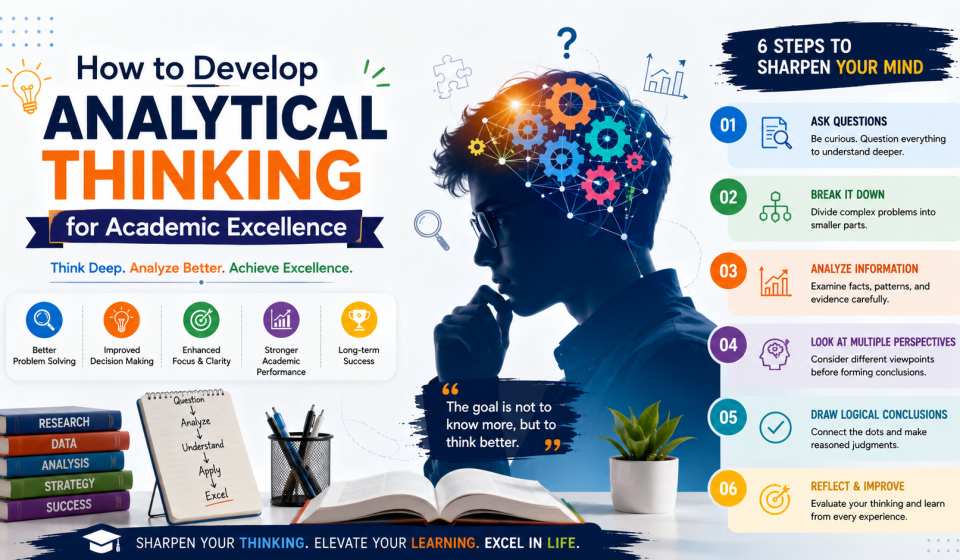

Learn how to develop analytical thinking for academic excellence through practical strategies that improve reasoning, problem-solving, decision-making, and learning skills.
Analytical thinking is an important skill that can help students understand difficult subjects, solve problems, evaluate information, and make better academic decisions. Instead of accepting information without examination, analytical thinkers learn to break complex topics into smaller parts, identify relationships, compare evidence, and reach logical conclusions.
Developing this ability does not happen overnight. It requires regular practice, curiosity, careful observation, and a willingness to question assumptions. By using practical strategies such as asking better questions, analyzing information, solving problems, reviewing mistakes, and connecting ideas across subjects, students can strengthen their analytical abilities and improve their overall academic performance.
What Is Analytical Thinking?
Analytical thinking is the ability to examine information carefully and understand how different parts relate to one another. It involves breaking a problem into smaller components, identifying relevant information, recognizing patterns, comparing alternatives, and using evidence to reach a reasonable conclusion.
For students, analytical thinking can be useful in almost every subject. It can help with mathematics, science, programming, literature, history, business, social sciences, and research-based assignments.
Analytical thinking is different from simply memorizing information. Memorization helps students remember facts, while analytical thinking helps them understand how and why those facts matter.
Why Analytical Thinking Matters for Academic Excellence
Improves Problem-Solving Skills
Academic work often involves problems that do not have an immediately obvious answer. Analytical thinking helps students understand the problem before attempting to solve it.
Instead of guessing, students can identify what is known, determine what is missing, consider possible approaches, and evaluate the results.
Helps Students Understand Complex Topics
Difficult subjects often contain several connected ideas. Analytical thinking allows students to separate those ideas and study them individually before understanding how they work together.
This approach can make complicated chapters, theories, formulas, and concepts easier to understand.
Supports Better Decision-Making
Students make many academic decisions, such as selecting courses, choosing research topics, deciding which sources to use, or determining how to approach a project.
Analytical thinking encourages students to compare options and consider evidence before making a decision.
Ask Better Questions
One of the simplest ways to develop analytical thinking is to become comfortable asking questions.
Instead of asking only “What is this?”, ask:
- Why does this happen?
- How does it work?
- What caused it?
- What evidence supports it?
- What would happen if something changed?
- Are there alternative explanations?
- How does this idea connect to something I already know?
These questions encourage deeper learning and prevent passive studying.
Break Complex Problems Into Smaller Parts
When a problem looks difficult, avoid trying to solve everything at once.
Break it into smaller questions. Identify the main objective, separate relevant information from unnecessary details, and solve each part systematically.
For example, when working on a programming assignment, first understand the required output, then identify the input, divide the problem into logical steps, write the solution, and test each part.
This method can also be applied to research papers, mathematical problems, presentations, and group projects.
Learn to Evaluate Information
Students encounter information from textbooks, websites, social media, videos, articles, and other sources. Not every piece of information has the same level of reliability.
When researching a topic, consider:
- Who created the information?
- What evidence is provided?
- Is the information supported by reliable sources?
- When was it published or updated?
- Is the source presenting facts or opinions?
- Are alternative viewpoints considered?
Learning to evaluate information carefully is especially useful when completing research assignments.
Compare Different Perspectives
Analytical thinking becomes stronger when students learn to consider more than one perspective.
When studying a controversial or complex topic, identify different arguments and examine the evidence supporting each position.
Ask yourself what each perspective explains well and where its limitations may exist. This does not mean treating every viewpoint as equally accurate. Instead, it means examining information fairly before reaching a conclusion.
Practice Logical Reasoning
Logical reasoning involves connecting information in a structured way.
You can practice by solving:
- Mathematics problems.
- Logic puzzles.
- Programming challenges.
- Case studies.
- Research questions.
- Strategy games.
- Analytical exercises.
The purpose is not simply to find an answer. Try to understand why the answer is correct and whether another approach could produce the same result.
Read Actively
Reading can become a powerful analytical exercise when students move beyond simply finishing a chapter.
While reading, identify the author’s main argument, supporting evidence, assumptions, and conclusions.
After completing a section, ask yourself:
What is the main idea?
What evidence supports it?
Do I agree with the reasoning?
How does this connect to what I already know?
This approach turns reading into active learning.
Take Analytical Notes
Traditional notes often focus on recording everything the teacher says. Analytical notes focus more on relationships between ideas.
Try organizing notes using categories such as:
Main concept
Evidence
Example
Cause
Effect
Question
Conclusion
You can also create concept maps to show how different ideas connect.
Learn From Your Mistakes
Mistakes can provide valuable information about your thinking process.
Instead of correcting an incorrect answer and immediately moving on, ask:
- Where did I make the mistake?
- Did I misunderstand the question?
- Did I use the wrong method?
- Did I overlook important information?
- Was my reasoning incomplete?
- How can I avoid the same mistake?
Keeping a mistake journal can be especially useful for mathematics, science, languages, and technical subjects.
Use the “Why” Technique
Repeatedly asking “why” can help students explore the underlying causes of a problem.
For example:
Why did the experiment produce this result?
Because one variable changed.
Why did that variable affect the result?
Because it influenced the process being studied.
Continue investigating until you reach a deeper understanding rather than stopping at the first explanation.
Connect Different Subjects
Analytical thinking becomes stronger when students learn to connect ideas from different areas.
For example, mathematics can support data analysis, programming can involve logical reasoning, history can involve evaluating evidence, and writing can require constructing a logical argument.
Look for connections between subjects instead of treating every course as completely separate.
Practice With Real-World Problems
Academic concepts become easier to understand when applied to realistic situations.
For example, students studying business can analyze a company’s strategy. Computer science students can solve practical programming problems. Science students can examine real-world data, while economics students can study how changes in one factor affect another.
Real-world applications encourage students to think beyond memorized definitions.
Improve Your Research Skills
Research assignments provide excellent opportunities to develop analytical thinking.
Start by defining the research question clearly. Then collect information from credible sources, compare evidence, identify patterns, and organize your findings before writing your conclusion.
Avoid copying information without understanding it. Explain ideas in your own words and connect evidence directly to your argument.
Discuss Ideas With Others
Academic discussions can expose students to different ways of thinking. Talking about a difficult topic with classmates, teachers, mentors, or study groups can reveal questions or perspectives you had not considered.
When discussing an idea, focus on reasoning rather than simply trying to prove that your opinion is correct.
Ask others why they reached their conclusions and compare their reasoning with your own.
Develop a Habit of Reflection
Reflection helps students understand how they learn and think.
At the end of a study session, ask:
- What did I learn?
- What was difficult?
- What strategy worked?
- What mistake did I make?
- What do I still not understand?
- What should I study next?
This short process can gradually improve learning strategies and academic performance.
Practical Daily Exercises for Analytical Thinking
Students can develop analytical thinking through small daily activities.
Try to:
- Solve one challenging problem each day.
- Read an article and identify its main argument.
- Compare two explanations of the same topic.
- Explain a difficult concept in your own words.
- Analyze why you made a mistake.
- Create a mind map for a complex topic.
- Ask “why” and “how” questions while studying.
- Discuss academic topics with classmates.
- Practice puzzles or reasoning exercises.
Consistency is more important than spending several hours on analytical exercises once a week.
Common Mistakes That Limit Analytical Thinking
Relying Only on Memorization
Memorization is useful, but students should also understand concepts and relationships.
Accepting Information Without Questioning It
Students should learn to examine evidence and consider the reliability of sources.
Looking Only for One Answer
Some academic problems have multiple reasonable approaches. Comparing methods can improve understanding.
Avoiding Difficult Problems
Challenging questions provide opportunities to practice reasoning. Instead of immediately looking for an answer, spend time understanding the problem first.
Source Links
https://www.oecd.org/education
https://learningcenter.unc.edu
https://www.apa.org/education-career
Conclusion
Analytical thinking is a valuable academic skill that helps students understand information, solve problems, evaluate evidence, and make thoughtful decisions. It goes beyond memorizing facts by encouraging learners to ask questions, examine relationships, compare perspectives, and develop conclusions based on reasoning.
Students can strengthen analytical thinking through regular practice. Breaking complex problems into smaller parts, reading actively, evaluating sources, learning from mistakes, discussing ideas, and applying knowledge to real-world situations can gradually improve analytical abilities.
Academic excellence is not based only on how much information a student can remember. The ability to understand, analyze, apply, and evaluate knowledge is equally important. By making analytical thinking part of everyday study habits, students can become more independent, confident, and effective learners.
Frequently Asked Questions (FAQs)
1. What is analytical thinking in education?
Analytical thinking is the ability to examine information, break problems into smaller parts, identify relationships, evaluate evidence, and reach logical conclusions. It helps students understand subjects more deeply instead of relying only on memorization.
2. Why is analytical thinking important for students?
Analytical thinking helps students solve problems, evaluate information, understand complex concepts, and make better academic decisions. It can be useful across almost every subject.
3. How can I improve my analytical thinking skills?
Practice asking questions, solving problems, evaluating evidence, comparing perspectives, and reviewing mistakes. Regular practice is one of the most effective ways to strengthen analytical abilities.
4. Does analytical thinking improve academic performance?
It can support academic performance by helping students understand concepts more deeply and approach challenging questions systematically. However, academic success also depends on factors such as consistent study, effective communication, time management, and subject knowledge.
5. Can reading improve analytical thinking?
Yes. Active reading can help students identify arguments, evidence, assumptions, conclusions, and relationships between ideas. Asking questions while reading makes the activity more analytical.
6. How can students practice analytical thinking every day?
Students can solve challenging problems, analyze articles, create concept maps, compare viewpoints, explain concepts in their own words, and reflect on mistakes. Even short daily practice can be valuable.
7. Is analytical thinking the same as critical thinking?
They are closely related but not identical. Analytical thinking focuses strongly on breaking information or problems into parts and understanding relationships, while critical thinking also involves evaluating the quality, credibility, and implications of information.
8. How does analytical thinking help with exams?
Analytical thinking can help students understand questions, identify relevant information, compare possible answers, and apply concepts to unfamiliar problems. It can be particularly useful for subjects that require reasoning rather than simple recall.
9. Can analytical thinking be learned?
Yes. Analytical thinking is a skill that can be developed through practice and experience. Students can gradually improve by challenging their assumptions, solving problems, evaluating evidence, and reflecting on their reasoning.
10. What is the best habit for developing analytical thinking?
One of the most useful habits is to avoid accepting information immediately and instead ask questions such as “Why?”, “How?”, and “What evidence supports this?” Combining curiosity with regular problem-solving and reflection can steadily strengthen analytical thinking.