
Learn how to prepare for group discussions and personal interviews with practical tips for communication, confidence, research, common questions, and professional presentation.
Group discussions and personal interviews are important parts of many college placements, internships, scholarship selections, and job recruitment processes. While academic qualifications can help you reach the selection stage, your ability to communicate clearly, work with others, present your ideas, and respond confidently can strongly influence how interviewers evaluate you.
Preparing for these stages does not mean memorizing perfect answers. Effective preparation involves understanding the organization, practicing communication, developing awareness of current topics, preparing for common questions, and learning how to remain calm under pressure. With regular practice, students can become more comfortable expressing their ideas and handling unexpected questions.
Understand the Selection Process
Before preparing, find out what the selection process involves. Some organizations may conduct an aptitude test before a group discussion and interview, while others may include technical assessments, presentations, or additional interview rounds.
Knowing the process allows you to prepare for each stage separately.
Research:
- Number of selection rounds.
- Type of group discussion.
- Interview format.
- Technical or subject-related requirements.
- Documents required.
- Organization background.
- Position or course requirements.
This information can help you avoid last-minute confusion.
Research the Organization
Learning about the organization is one of the most important preparation steps.
Visit its official website and learn about its:
- Products or services.
- Mission and values.
- Industry.
- Recent developments.
- Work culture.
- Major areas of operation.
- Job or internship requirements.
During an interview, this knowledge can help you give more specific answers to questions such as “Why do you want to join us?”
Understand Group Discussions
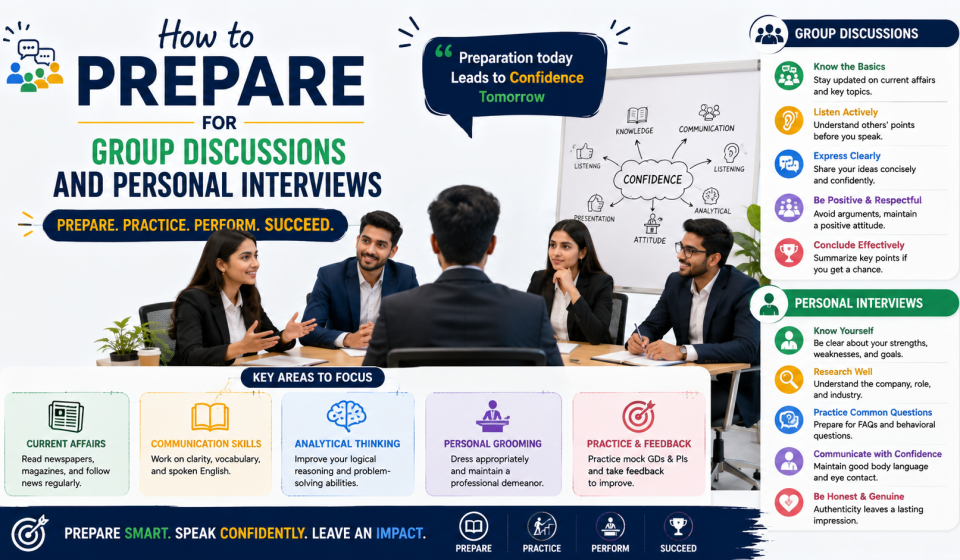
A group discussion is designed to assess how participants communicate and interact while discussing a topic. Interviewers may observe several qualities rather than simply looking for the person who speaks the most.
They may consider:
- Communication skills.
- Confidence.
- Listening ability.
- Logical thinking.
- Teamwork.
- Awareness of the topic.
- Respect for different opinions.
- Ability to organize ideas.
- Leadership potential.
The objective is not to dominate the discussion. It is to contribute useful ideas while allowing others to participate.
Prepare for Common Group Discussion Topics
Group discussion topics can vary widely. They may involve education, technology, business, society, environment, workplace trends, or abstract ideas.
Prepare by regularly reading reliable news and educational sources. Practice discussing topics such as:
- Artificial intelligence in education.
- Online learning.
- Social media and students.
- Technology and employment.
- Remote work.
- Environmental sustainability.
- Digital privacy.
- Importance of communication skills.
The goal is not to memorize speeches. Build enough understanding to form an informed opinion.
How to Start a Group Discussion
If you understand the topic well, starting the discussion can help you demonstrate confidence.
A simple structure is:
Introduce the topic → Define the main issue → Present one important point → Invite discussion
For example:
“Online education has changed how students access learning. It provides flexibility and access to educational resources, but it can also create challenges related to engagement and practical learning. We can look at both sides before reaching a conclusion.”
Keep your opening concise. A long speech can prevent others from participating.
Speak Clearly and Concisely
One of the biggest mistakes in group discussions is speaking for too long.
Use a simple structure:
Point → Reason → Example → Conclusion
For example:
“Digital skills are becoming increasingly important for students. Many industries now use technology in everyday operations, so basic digital knowledge can improve employability. Students can develop these skills through projects, internships, and online learning. Therefore, digital education should complement traditional academic learning.”
A structured answer is usually easier to understand than a collection of unrelated points.
Learn to Enter the Discussion Politely
If someone is already speaking, do not interrupt aggressively.
You can use phrases such as:
- “I would like to add another point.”
- “I agree with that point, and I would also like to mention…”
- “I have a slightly different perspective.”
- “Building on that idea…”
- “May I add something here?”
Professional language demonstrates respect and teamwork.
Disagree Without Being Disrespectful
Disagreement is normal in group discussions. The important thing is how you express it.
Instead of saying:
“You are wrong.”
Try:
“I understand your point, but I see the issue differently because…”
Focus on the argument rather than the person. Support your position with reasoning or examples.
Listen Actively
Good communication is not only about speaking. Listening is equally important.
Pay attention to what other participants say. If you refer to another person’s point, make it clear that you understood it.
For example:
“I agree with the earlier point about accessibility. However, I think we should also consider the quality of learning and student engagement.”
This demonstrates attention, respect, and the ability to build on ideas.
Avoid Common Group Discussion Mistakes
Speaking Too Much
Talking continuously does not necessarily demonstrate leadership. Give others opportunities to contribute.
Staying Silent
You do not need to speak every minute, but remaining completely silent can make it difficult for evaluators to assess your communication and reasoning.
Interrupting Others
Frequent interruptions can make you appear disrespectful or overly aggressive.
Going Off Topic
Keep your points connected to the discussion question.
Using Unsupported Claims
Avoid presenting rumors or uncertain information as facts. If you are unsure, frame your statement carefully.
Prepare for the Personal Interview
After the group discussion, you may face a personal interview. The interview can focus on your education, skills, experience, career goals, personality, and suitability for the opportunity.
Review your resume carefully because interviewers may ask about anything listed on it.
Prepare Your Self-Introduction
“Tell me about yourself” is one of the most common interview questions.
A useful structure is:
Present → Education → Skills → Experience or Projects → Career Goal
For example:
“My name is [Name], and I am currently pursuing a degree in computer science. I am interested in web development and have worked on academic projects involving HTML, CSS, JavaScript, and databases. I have also been developing my communication and problem-solving skills through college activities. I am looking for an opportunity where I can apply my knowledge, gain practical experience, and continue learning.”
Keep your introduction professional and relatively brief.
Prepare for Common Interview Questions
Practice answering questions such as:
- Tell me about yourself.
- Why did you choose your field?
- What are your strengths?
- What is one area you are working to improve?
- Why should we select you?
- Why do you want this opportunity?
- What are your career goals?
- Tell me about a project you completed.
- Describe a challenge you faced.
- How do you handle teamwork?
- Where do you see yourself in the future?
Do not memorize answers word for word. Prepare key points so your responses sound natural.
Prepare for Technical or Subject Questions
Students applying for technical roles should revise important concepts from their academic field.
For example, a computer science student may need to review:
- Programming fundamentals.
- Object-oriented programming.
- Databases.
- SQL.
- HTML and CSS.
- Data structures.
- Software development concepts.
- Basic networking.
- Projects mentioned on the resume.
Be prepared to explain your projects clearly, including what you contributed, which technologies you used, and what challenges you encountered.
Use the STAR Method
For experience-based questions, the STAR method can help organize your answer.
S – Situation: Explain the context.
T – Task: Describe your responsibility.
A – Action: Explain what you did.
R – Result: Describe the outcome.
For example, if asked about teamwork, describe a real project where you worked with classmates, explain your responsibility, discuss how you handled a challenge, and mention the result.
Improve Your Body Language
Nonverbal communication can influence how your answers are perceived.
During an interview:
- Sit comfortably and professionally.
- Maintain appropriate eye contact.
- Avoid constantly looking at the floor.
- Keep your posture reasonably upright.
- Listen carefully.
- Avoid excessive hand movements.
- Use a natural facial expression.
Do not try to look completely emotionless. Professional confidence should feel natural rather than forced.
Dress Professionally
Choose clean, neat, and appropriate clothing. The exact dress code can depend on the organization and industry.
Make sure your clothing is comfortable enough that you can focus on the conversation rather than adjusting your appearance constantly.
Also carry necessary documents in an organized folder when requested.
Practice Mock Interviews
Mock interviews are one of the best ways to identify areas that need improvement.
Ask a friend, teacher, mentor, or career advisor to conduct a practice interview. Record yourself when possible and review:
- Speaking speed.
- Clarity.
- Repeated words.
- Body language.
- Length of answers.
- Confidence.
- Areas where you hesitate.
Practice can make unfamiliar questions feel less intimidating.
Build Confidence Through Preparation
Confidence usually develops from preparation rather than simply trying to appear confident.
Before an interview, review your resume, research the organization, revise relevant subjects, prepare questions, and practice your introduction.
Remember that you are not expected to know everything. If you do not know an answer, respond honestly rather than inventing information.
You can say:
“I am not familiar with that concept yet, but I would be interested in learning more about it.”
This is generally better than providing an inaccurate answer.
Prepare Questions for the Interviewer
At the end of an interview, you may be asked whether you have questions.
Useful questions can include:
- What would the main responsibilities of this role be?
- What skills are most important for success in this position?
- What does the training or onboarding process involve?
- How does the team typically collaborate?
- What opportunities are available for learning and development?
Avoid asking questions whose answers are already clearly available in the job description or organization website.
Manage Interview-Day Stress
Preparation should also include practical planning.
Before the interview:
- Confirm the location or online meeting link.
- Check the interview time.
- Prepare required documents.
- Test your microphone and camera for online interviews.
- Plan your travel route if attending in person.
- Get adequate rest.
- Eat appropriately.
- Arrive early.
Being prepared for logistical details can reduce unnecessary stress.
Source Links
https://www.indeed.com/career-advice/interviewing
Conclusion
Preparing for group discussions and personal interviews requires more than memorizing standard answers. Students should develop clear communication, active listening, logical reasoning, professional body language, and the ability to work respectfully with others. Regular practice can make it easier to express ideas confidently while responding naturally to unexpected situations.
For personal interviews, research the organization, understand the opportunity, review your resume, prepare common questions, and be ready to discuss your education, projects, skills, and career goals. For group discussions, focus on contributing useful ideas, listening to others, supporting your points with reasoning, and disagreeing respectfully when necessary.
The most effective preparation combines knowledge with practice. By participating in mock discussions, practicing interviews, reviewing relevant subjects, and learning from feedback, students can gradually become more confident and prepared for academic and professional selection processes.
Frequently Asked Questions (FAQs)
1. How early should I prepare for a group discussion and interview?
Start preparing several weeks before an important selection process when possible. Regular practice gives you time to improve communication, research organizations, revise subjects, and become comfortable answering questions.
2. What skills are assessed during a group discussion?
Evaluators may consider communication, listening, teamwork, confidence, logical reasoning, awareness, leadership, and respect for other participants. Speaking the most is not necessarily the same as performing well.
3. How can I improve my group discussion skills?
Practice discussing different topics with friends or classmates. Focus on organizing your thoughts, speaking clearly, listening carefully, supporting arguments with examples, and allowing others to participate.
4. What should I say when asked to introduce myself?
Briefly explain who you are, your education, relevant skills, projects or experience, and career interests. Keep the introduction professional and focused on information relevant to the opportunity.
5. What should I do if I do not know an interview answer?
Be honest rather than guessing or providing false information. You can explain that you are not familiar with the topic and express your willingness to learn it.
6. Should I memorize interview answers?
Avoid memorizing complete answers word for word. Prepare important points and practice explaining them naturally so your responses remain flexible and authentic.
7. How can I reduce nervousness before an interview?
Preparation, mock interviews, arriving early, and reviewing your key points can help reduce uncertainty. Take a few calm breaths before the interview and focus on answering one question at a time.
8. What should I wear for a personal interview?
Choose clean, neat, comfortable, and professional clothing that is appropriate for the organization and position. When in doubt, a simple professional appearance is generally a safe choice.
9. How important is body language during an interview?
Body language can influence how your communication is perceived. Appropriate eye contact, attentive listening, good posture, and a calm manner can support your verbal answers.
10. What is the best way to prepare for a group discussion?
Research common discussion topics, stay informed about relevant issues, practice speaking concisely, and participate in mock discussions. Focus on both communication and listening because effective group discussions require both.