
Learn how to choose between diploma, degree, and certification courses by comparing career goals, duration, cost, recognition, skills, and future education options.
Choosing the right educational course is an important decision for students and working professionals. Diploma, degree, and certification courses can all provide valuable knowledge and skills, but they differ in duration, depth, entry requirements, cost, recognition, and career applications. Understanding these differences can help learners select an option that matches their goals rather than choosing a course simply because it is popular.
The best choice depends on what you want to achieve. Some learners may benefit from a degree because they want a broad academic foundation and access to careers that require formal higher education. Others may prefer a diploma for practical and focused training, while certification courses can be useful for developing or validating specific skills. Before making a decision, consider your career plans, educational background, available time, budget, and long-term goals.
Understanding the Difference Between Diploma, Degree, and Certification
Before comparing the options, it is important to understand what each type of course generally represents.
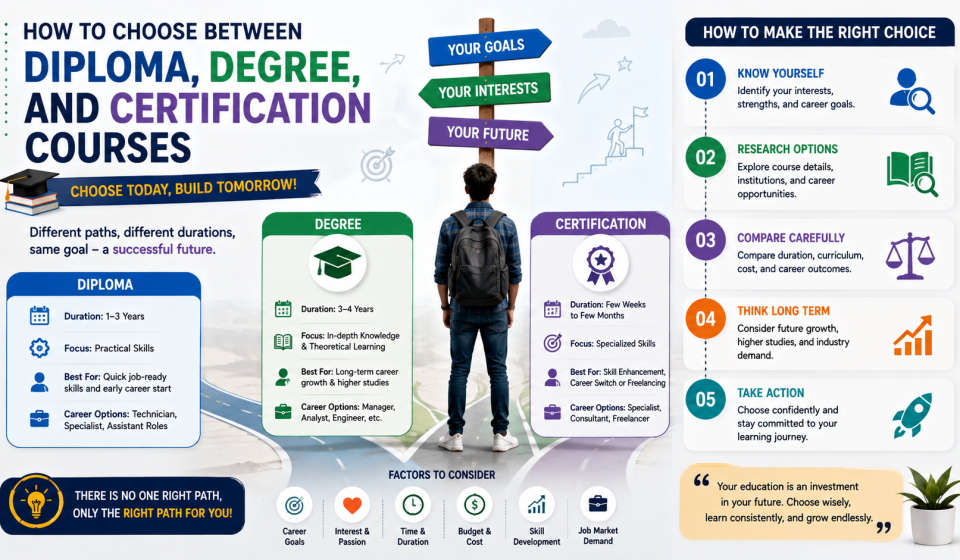
A degree is usually a broader academic qualification offered by a recognized higher education institution. It can provide theoretical knowledge, practical learning, and a wider foundation in a particular field.
A diploma is generally more focused and may emphasize practical or occupational skills. Diploma programs can vary significantly in length and recognition depending on the institution and country.
A certification generally demonstrates completion of a specific course, assessment, or competency. Professional certifications can be especially useful for specialized skills and continuing education.
The exact meaning and recognition of these qualifications can vary by country, institution, and profession.
Consider Your Career Goal First
Your career goal should be the starting point when choosing an educational pathway.
Ask yourself:
- What job do I want?
- Does that career require a degree?
- Do I need a specific professional license?
- Am I looking for practical skills?
- Do I want to change careers?
- Do I plan to pursue higher education later?
- Do I need a qualification quickly?
For example, a career that requires a specific university degree may not be suitable for someone who completes only a short certification course.
On the other hand, if your goal is to learn a particular software tool or develop a specialized professional skill, a certification may be more appropriate.
When a Degree May Be the Better Choice
A degree can be suitable for students who want a comprehensive education and are prepared to make a longer-term academic commitment.
Degrees can provide:
- Broad subject knowledge.
- Structured academic learning.
- Research experience.
- Opportunities for internships.
- Access to certain graduate programs.
- A recognized higher education qualification.
A degree may be particularly important in professions where employers or regulators require a specific level of formal education.
However, students should research the requirements of their intended career before enrolling.
When a Diploma May Be the Better Choice
A diploma may be appropriate for learners who want focused education with a stronger practical orientation.
Diploma programs can be useful for:
- Developing job-related skills.
- Entering a particular vocational field.
- Building practical knowledge.
- Exploring a career before pursuing further education.
- Improving employability in certain occupations.
The quality and recognition of diploma programs can vary considerably. Always check whether the institution and qualification are recognized by the relevant educational authorities or industry.
When Certification May Be the Better Choice
Certification courses are often useful when learners want to develop a specific skill or demonstrate knowledge in a particular area.
Examples can include certifications related to:
- Information technology.
- Digital marketing.
- Project management.
- Data analysis.
- Cybersecurity.
- Cloud computing.
- Accounting software.
- Professional tools.
Certifications can be especially useful for students and professionals who already have foundational education and want to add specialized skills.
Compare Course Duration
Time is an important factor.
Degree programs generally require a longer commitment than many diploma or certification programs. Diplomas can range from relatively short programs to multi-year courses, while certifications may take anywhere from a few weeks to several months or longer.
Do not choose a shorter course simply because it is faster. Ask whether the course provides enough depth and practical training for your intended career.
Consider the Cost
Education can be a significant financial investment.
When comparing programs, look beyond the advertised tuition fee. Consider:
- Registration fees.
- Examination costs.
- Books and learning materials.
- Software requirements.
- Transportation.
- Accommodation.
- Technology expenses.
- Internship-related costs.
A more expensive course is not automatically better. Compare the quality, recognition, curriculum, practical opportunities, and potential career relevance.
Check Recognition and Accreditation
Recognition is one of the most important factors when selecting a course.
Before enrolling, research:
- Who awards the qualification?
- Is the institution recognized?
- Is the program accredited where applicable?
- Do employers in the target industry recognize it?
- Can the qualification be used for further education?
- Is the certification provider reputable?
A qualification from an unknown provider may not have the same value as one from a recognized institution or respected professional organization.
Examine the Curriculum
Do not choose a course based only on its title.
Read the curriculum carefully and identify the subjects, practical components, assessments, and learning outcomes.
Ask whether the curriculum teaches skills that are actually relevant to your career goal.
For example, a student interested in web development should examine whether a program includes practical development work, relevant programming technologies, databases, testing, and project experience.
Look at Practical Learning Opportunities
Practical experience can make education more valuable.
Check whether the program includes:
- Projects.
- Laboratories.
- Internships.
- Case studies.
- Simulations.
- Industry assignments.
- Practical assessments.
A course that combines theoretical knowledge with practical application may help learners understand how concepts are used in real situations.
Consider Your Current Education Level
Your current educational background can influence the best choice.
A school graduate may choose a diploma or undergraduate degree depending on career requirements. A university graduate may choose a certification to specialize in a particular skill.
Professionals may also use certifications or advanced diplomas to update their knowledge without returning to a full-time degree program.
Think About Further Education
Consider whether you want to continue studying after completing the course.
Ask:
- Can this qualification lead to another program?
- Will credits transfer?
- Can I pursue advanced study afterward?
- Does the institution recognize prior learning?
Not every diploma or certification automatically provides a pathway to a degree. Confirm the progression options before enrolling.
Compare Learning Formats
Education is available in many formats.
You may find:
- Full-time programs.
- Part-time programs.
- Online courses.
- Hybrid programs.
- Evening classes.
- Weekend programs.
Choose a format that fits your schedule and learning preferences.
Online learning can provide flexibility, but students should check whether the course includes adequate instructor support, practical activities, assessments, and credible recognition.
Evaluate the Institution and Instructors
The quality of the institution can influence your educational experience.
Research:
- Faculty qualifications.
- Student support.
- Learning resources.
- Industry connections.
- Internship opportunities.
- Graduate outcomes where reliable data is available.
- Student reviews from trustworthy sources.
Do not rely entirely on promotional claims. Compare information from multiple reliable sources.
Consider Industry Requirements
Different industries value qualifications differently.
Some employers may prioritize degrees, while others may place significant emphasis on practical skills, portfolios, experience, or professional certifications.
Review current job descriptions for your target career and identify commonly requested qualifications and skills.
This can give you a better understanding of what employers actually expect.
Think About Your Learning Style
Your preferred learning style can also influence your choice.
A degree may suit someone who enjoys structured academic study, research, and broad subject exploration.
A diploma may suit someone who prefers focused and practical training.
A certification may be appropriate for someone who wants targeted learning around a specific skill or professional competency.
There is no universally best option.
Consider Your Budget and Time
Create a realistic education budget before enrolling.
Compare the total cost with the time commitment and expected career relevance. If you need to work while studying, a part-time diploma or certification may provide greater flexibility than a full-time program.
However, avoid making the decision based only on immediate affordability. Consider whether the qualification supports your long-term career plans.
Avoid Choosing Based Only on Trends
Popular courses can attract many students, but popularity does not guarantee suitability.
A course should be selected based on:
- Your interests.
- Your abilities.
- Career requirements.
- Course quality.
- Industry relevance.
- Future opportunities.
Technology and job markets can change, so focus on developing transferable skills alongside specialized knowledge.
Compare Options Before Making a Decision
Create a simple comparison table for the programs you are considering.
Compare:
Recognition: Is the qualification officially or professionally recognized?
Duration: How long will it take?
Cost: What is the complete cost?
Curriculum: Does it teach relevant skills?
Practical Experience: Are projects or internships included?
Career Relevance: Does it match your target jobs?
Future Study: Can you progress to another qualification?
Flexibility: Can you balance it with other responsibilities?
This process can make your decision more objective.
Questions to Ask Before Enrolling
Before paying for a course, ask the institution:
- What qualification will I receive?
- Who recognizes the qualification?
- What are the admission requirements?
- What is the complete cost?
- What subjects are included?
- Are practical projects included?
- Are internships available?
- What are the assessment methods?
- Can I continue to higher education afterward?
- What support is available to students?
Getting clear answers can prevent unpleasant surprises later.
Common Mistakes to Avoid
Choosing Only Based on Course Duration
A shorter course is not automatically better. Consider whether it provides the necessary depth and recognition.
Ignoring Accreditation
Always verify whether the institution and qualification are appropriately recognized.
Following Friends
Your friend’s career goals may be completely different from yours. Choose based on your own interests and requirements.
Focusing Only on Salary
Salary information can change by location, experience, industry, and role. Consider job suitability and long-term development as well.
Choosing Without Research
Compare several programs before making a financial or academic commitment.
Source Links
https://www.unesco.org/en/education
https://www.oecd.org/education
Conclusion
Choosing between a diploma, degree, and certification course requires careful consideration of your career goals, educational background, budget, available time, and the requirements of your intended profession. A degree may be appropriate for careers that require broad academic preparation, while a diploma can provide focused practical training and a certification can help develop or demonstrate specialized skills.
There is no single option that is best for every learner. The right choice depends on what you want to achieve and how the qualification fits into your longer-term education and career plan.
Before enrolling, research the institution, recognition, curriculum, practical opportunities, cost, duration, and progression options. Taking time to compare your choices can help you invest in an educational pathway that provides meaningful skills and supports your future goals.
Frequently Asked Questions (FAQs)
1. Is a degree better than a diploma?
Not necessarily. A degree may be required for certain careers and can provide broader academic preparation, while a diploma may offer more focused practical training. The better option depends on the learner’s career goals and industry requirements.
2. Is a certification better than a degree?
A certification and degree serve different purposes. Certifications are often focused on specific skills, while degrees usually provide broader academic education and may be required for certain professional paths.
3. Which course is best for getting a job quickly?
A practical diploma or relevant certification may help some learners enter specific occupations more quickly, but this depends on the industry and employer requirements. Always check current job requirements before choosing a course.
4. How do I know whether a course is recognized?
Check the official status of the institution and qualification with the relevant educational authority or professional organization. You can also review whether employers and educational institutions recognize the qualification.
5. Should I choose a course based on salary?
Salary should be one consideration, but it should not be the only factor. Consider your interests, abilities, career requirements, employment opportunities, work environment, and long-term development.
6. Can a diploma lead to a degree?
In some education systems and institutions, certain diploma programs may provide pathways into degree programs. However, this is not automatic, so check the specific institution’s progression and credit-transfer policies.
7. Are online certifications valuable?
Online certifications can be valuable when they come from credible providers and teach relevant skills. Their usefulness depends on factors such as industry recognition, assessment quality, course content, and how well the skills match your career goals.
8. How long does it take to complete a certification?
The duration varies significantly. Some certifications can be completed relatively quickly, while more advanced professional certifications may require months of preparation and experience.
9. What should I check before choosing a diploma course?
Check the institution’s recognition, curriculum, duration, total cost, practical training, faculty, internship opportunities, career relevance, and options for further education.
10. Can I take a certification after completing a degree?
Yes. Many graduates pursue certifications after completing a degree to develop specialized skills or strengthen their professional profile. Certifications can be particularly useful when they relate directly to a target industry or role.