
Learn the best methods to improve academic writing skills, including research, structure, grammar, critical thinking, citations, editing, and effective writing practices.
Academic writing is an important skill for students at school, college, and university. Essays, research papers, reports, assignments, dissertations, and presentations often require students to communicate ideas clearly, organize information logically, use reliable evidence, and follow appropriate academic standards. Strong writing can make it easier for readers to understand an argument and evaluate the quality of the work.
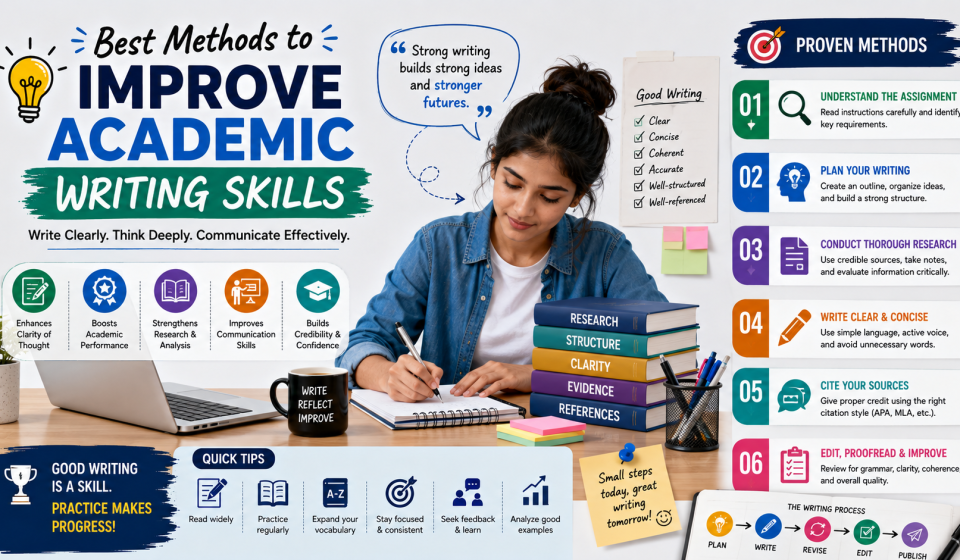
Improving academic writing takes regular practice rather than relying on one technique. Students can become better writers by reading high-quality academic material, planning before writing, developing clear arguments, using evidence effectively, improving grammar and vocabulary, learning appropriate citation practices, and carefully editing their work before submission.
Understand the Purpose of Academic Writing
Academic writing is different from casual writing. It usually requires a clear purpose, logical organization, evidence-based arguments, and a formal style.
Before starting an assignment, identify what the task requires. Look carefully at instruction words such as:
- Analyze.
- Compare.
- Evaluate.
- Discuss.
- Explain.
- Describe.
- Critically examine.
Understanding the question helps you determine what type of response you need to produce.
Read Academic Writing Regularly
One of the best ways to improve writing is to read good writing.
Read:
- Academic articles.
- Research papers.
- Textbooks.
- University resources.
- Well-written essays.
- Reports from credible organizations.
While reading, observe how authors introduce topics, present arguments, use evidence, connect paragraphs, and reach conclusions.
Do not simply focus on the information. Pay attention to how the information is communicated.
Build a Strong Vocabulary
A strong academic vocabulary can help students express ideas more precisely. However, academic writing does not require using complicated words unnecessarily.
Instead of trying to use impressive vocabulary, focus on choosing accurate words.
For example, instead of repeatedly using “shows,” depending on the context you might use:
- Demonstrates.
- Indicates.
- Suggests.
- Illustrates.
- Highlights.
- Reveals.
Learn new words through reading and understand how they are used before adding them to your own writing.
Understand the Assignment Question
Many writing problems begin before the first sentence is written.
Read the assignment question carefully and identify:
- The main topic.
- The required task.
- The scope.
- Important concepts.
- Required evidence.
- Word limit.
- Formatting requirements.
If the question asks you to evaluate an issue, simply describing the issue may not be enough. Your writing should include analysis and judgment supported by evidence.
Research Before Writing
Good academic writing depends on reliable information.
Before writing, gather relevant sources from appropriate places such as:
- Academic journals.
- University publications.
- Books.
- Government websites.
- Research organizations.
- Professional institutions.
- Reputable educational resources.
Avoid relying heavily on random websites or unsupported online claims.
Take notes while researching and record source details so that you can cite information correctly later.
Create an Outline
Writing without a plan can lead to repetition, weak arguments, and poor organization.
Create a simple outline before beginning.
For example:
Introduction
- Background.
- Topic.
- Main argument.
Body Paragraph 1
- Main point.
- Evidence.
- Explanation.
Body Paragraph 2
- Main point.
- Evidence.
- Analysis.
Body Paragraph 3
- Alternative perspective.
- Evidence.
- Evaluation.
Conclusion
- Main findings.
- Final interpretation.
An outline does not need to be complicated. Its purpose is to give your writing direction.
Write a Clear Introduction
The introduction should help readers understand what the assignment is about.
A strong introduction can include:
- Background information.
- Context for the topic.
- The central issue.
- The purpose of the paper.
- A thesis or main argument.
Avoid including too much detailed evidence in the introduction. Save most supporting information for the main body.
Develop a Strong Thesis Statement
A thesis statement communicates the main argument or position of your paper.
A weak thesis might simply state:
“Technology has changed education.”
A stronger version could explain the specific argument:
“Digital learning technologies have expanded access to education, but their effectiveness depends on student engagement, teacher support, and reliable access to technology.”
The second statement gives the reader a clearer idea of what the paper will examine.
Build Strong Paragraphs
Each body paragraph should usually focus on one main idea.
A useful structure is:
Topic sentence → Evidence → Explanation → Analysis → Link
The topic sentence introduces the paragraph’s main point. Evidence supports the point, while explanation and analysis show why the evidence matters.
Avoid putting several unrelated ideas into one paragraph.
Use Evidence Effectively
Academic writing should not depend entirely on personal opinions. Use evidence to support important claims.
When using evidence, explain:
- What the evidence says.
- Where it comes from.
- Why it is relevant.
- How it supports your argument.
Simply adding a quotation or statistic does not automatically strengthen an argument. The writer must connect the evidence to the main point.
Develop Critical Thinking
Academic writing requires more than summarizing information.
Critical academic writing may involve:
- Comparing different viewpoints.
- Identifying strengths and limitations.
- Evaluating evidence.
- Recognizing assumptions.
- Considering alternative explanations.
- Drawing logical conclusions.
For example, instead of writing:
“Researchers say online learning is effective.”
You could examine what the research measured, which students were studied, what limitations existed, and whether the findings apply to other situations.
Use Transitions
Transitions help readers understand relationships between ideas.
Useful transition words and phrases include:
Adding information: Furthermore, additionally, moreover.
Contrasting: However, in contrast, nevertheless.
Cause and effect: Therefore, consequently, as a result.
Examples: For example, for instance, such as.
Concluding: Overall, in conclusion, ultimately.
Use transitions naturally. Adding them to every sentence can make writing sound repetitive.
Avoid Unnecessary Words
Academic writing should be clear rather than unnecessarily complicated.
Instead of:
“Due to the fact that students are required to…”
Use:
“Because students are required to…”
Instead of:
“In order to improve…”
Use:
“To improve…”
Shorter expressions are often easier to understand.
Improve Sentence Structure
Use a mixture of sentence lengths while keeping your writing clear.
Very long sentences can contain multiple ideas and become difficult to follow. Very short sentences can make an academic paper feel disconnected.
After writing a long sentence, check whether it should be divided into two sentences.
Learn Correct Citation Practices
Citations are an important part of academic writing because they show where information and ideas came from.
Depending on your institution or subject, you may be required to use a specific style such as:
- APA.
- MLA.
- Chicago.
- Harvard.
- IEEE.
Follow your institution’s guidelines carefully.
Never present another person’s ideas, words, data, or research findings as your own.
Paraphrase Correctly
Paraphrasing means expressing information from a source in your own words while preserving the original meaning.
Simply changing a few words is not enough. Read the source, understand the idea, put it aside, and explain the concept naturally in your own writing. You should still provide a citation when required.
Use Quotations Carefully
Direct quotations can be useful when the exact wording is important, but academic writing should not become a collection of quotations.
Use quotations selectively and explain their relevance. In many cases, paraphrasing and analyzing the source may provide more value than quoting long passages.
Edit in Multiple Stages
Do not assume your first draft is your final version.
Edit your work in stages.
First Review: Content
Check whether your argument answers the assignment question and whether important points are missing.
Second Review: Structure
Check whether paragraphs are logically ordered and connected.
Third Review: Language
Look for grammar, spelling, punctuation, and unclear sentences.
Final Review: Formatting
Check citations, references, headings, word count, spacing, and submission requirements.
Read Your Work Aloud
Reading your paper aloud can reveal problems that are easy to miss while reading silently.
You may notice:
- Repeated words.
- Awkward sentences.
- Missing words.
- Unclear explanations.
- Excessively long sentences.
- Weak transitions.
If a sentence sounds confusing when spoken, it may need revision.
Use Feedback to Improve
Feedback is one of the most valuable tools for improving academic writing.
Ask a teacher, professor, writing tutor, or trusted classmate to review your work when appropriate.
Do not focus only on corrections. Look for patterns.
If feedback repeatedly mentions unclear arguments, weak structure, or insufficient analysis, make those areas a priority in your next assignment.
Practice Regularly
Writing improves through repeated practice.
You can practice by:
- Writing short analytical paragraphs.
- Summarizing academic articles.
- Explaining complex ideas in simple language.
- Writing thesis statements.
- Comparing two viewpoints.
- Keeping a research journal.
- Revising old assignments.
Regular practice is often more effective than trying to improve everything immediately before an important submission.
Common Academic Writing Mistakes
Writing Without a Plan
Starting immediately without understanding the question can lead to an unfocused paper.
Using Weak Sources
Unreliable sources can reduce the credibility of your argument.
Overusing Complex Words
Academic writing should be precise, not unnecessarily complicated.
Summarizing Instead of Analyzing
A strong academic paper explains why information matters and how it supports the argument.
Ignoring Editing
Grammar and structural problems can remain even when the ideas are strong.
Poor Citation Practices
Failing to acknowledge sources can create academic integrity problems.
A Simple Academic Writing Checklist
Before submitting an assignment, ask:
- Did I answer the exact question?
- Is my main argument clear?
- Does each paragraph have a purpose?
- Have I supported important claims with appropriate evidence?
- Did I explain the evidence?
- Are my sources reliable?
- Are citations complete and consistent?
- Is the writing clear and concise?
- Did I check grammar and spelling?
- Did I follow the required format?
Source Links
Conclusion
Improving academic writing skills requires a combination of reading, research, planning, writing, analysis, and revision. Students can make significant progress by understanding assignment requirements, creating outlines, developing clear arguments, using reliable evidence, organizing paragraphs effectively, and applying appropriate citation practices.
Good academic writing is not about using the most complicated vocabulary or producing long sentences. It is about communicating ideas clearly, supporting arguments with evidence, analyzing information thoughtfully, and guiding readers through a logical discussion.
The most effective approach is to treat writing as a process rather than a single activity. Plan carefully, write a first draft, review your ideas, improve your structure, correct language problems, and learn from feedback. With regular practice, students can become more confident and effective academic writers.
Frequently Asked Questions (FAQs)
1. How can I improve my academic writing skills quickly?
Start by improving one area at a time, such as paragraph structure, thesis statements, or grammar. Regular reading and writing practice can produce steady improvement over time.
2. What is the most important part of academic writing?
A clear argument supported by relevant evidence is one of the most important elements. Your writing should directly address the assignment question and explain why your evidence supports your position.
3. How can reading improve academic writing?
Reading quality academic material exposes you to formal vocabulary, sentence structures, argument development, evidence use, and effective organization. Studying how experienced writers communicate ideas can improve your own writing choices.
4. Should academic writing use complicated vocabulary?
No. Academic writing should prioritize clarity and precision. Complicated words should only be used when they accurately communicate a specific meaning.
5. How can I make my paragraphs stronger?
Give each paragraph a clear main idea and support it with relevant evidence and analysis. Make sure the paragraph connects logically to your overall argument.
6. Why is a thesis statement important?
A thesis statement communicates the central argument or position of your paper. It gives readers a clear understanding of what the paper will discuss or demonstrate.
7. How can I avoid plagiarism in academic writing?
Use your own wording when paraphrasing, place direct quotations appropriately, and cite information and ideas that come from other sources. Follow your institution’s academic integrity and citation requirements.
8. How many sources should an academic paper have?
There is no universal number because requirements vary by assignment, subject, and academic level. Follow your instructor’s guidelines and focus on using sufficient high-quality sources to support your argument.
9. Should I edit my academic paper after writing it?
Yes. Editing is an essential part of the writing process. Review content, organization, clarity, grammar, citations, and formatting before submitting your work.
10. How often should students practice academic writing?
Regular practice is beneficial. Writing short analytical paragraphs, summaries, essays, or research notes each week can gradually improve structure, vocabulary, reasoning, and confidence.