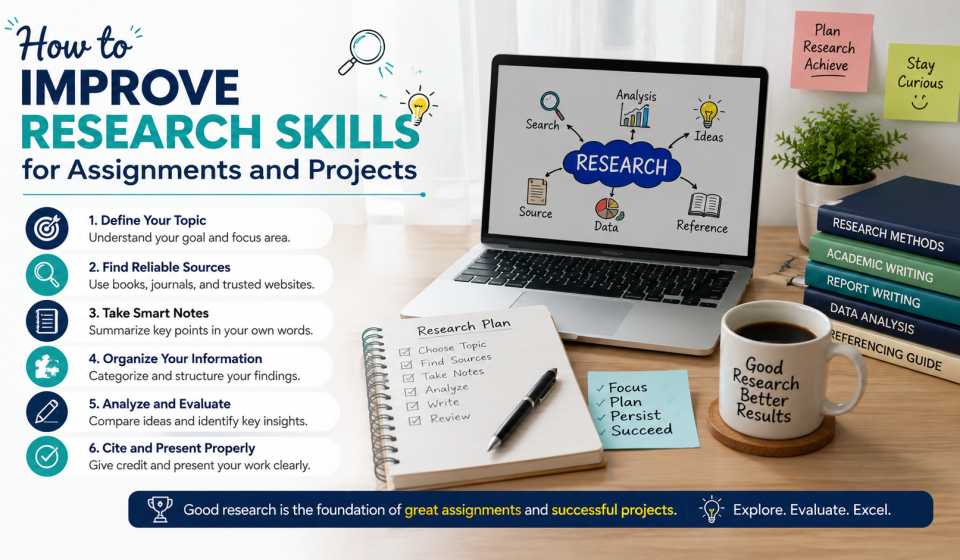

Learn how to improve research skills for assignments and projects. Discover effective research methods, credible sources, note-taking strategies, and techniques to produce high-quality academic work.
Strong research skills are essential for academic success. Whether you are preparing a university assignment, completing a school project, or writing a research paper, the ability to find, evaluate, and organize information helps you produce accurate and well-structured work. Good research also improves critical thinking and enables you to develop stronger arguments supported by reliable evidence.
Improving your research skills takes practice and a systematic approach. By learning how to identify trustworthy sources, take effective notes, and analyse information carefully, you can complete assignments with greater confidence and achieve better academic results.
Why Research Skills Are Important
Research skills help students gather reliable information and create well-supported assignments.
Benefits include:
- Better academic performance
- Improved critical thinking
- Stronger problem-solving abilities
- More accurate assignments
- Better decision-making
- Increased confidence
- Enhanced analytical skills
Good research forms the foundation of quality academic work.
Understand the Assignment Requirements
Before beginning your research, carefully read the assignment instructions.
Pay attention to:
- Assignment objectives
- Research questions
- Word count
- Submission deadline
- Required format
- Referencing style
- Assessment criteria
Understanding the requirements helps you stay focused throughout the research process.
Choose Reliable Sources
Using credible information improves the quality of your assignments.
Reliable sources include:
- Academic journals
- University library resources
- Government publications
- Educational websites
- Books by recognised authors
- Research databases
Avoid relying solely on unverified websites or outdated information.
Develop Effective Search Techniques
Searching efficiently saves time and improves research quality.
Helpful strategies include:
- Use specific keywords
- Try different keyword combinations
- Use quotation marks for exact phrases
- Explore related topics
- Filter results by publication date
- Compare information from multiple sources
Refining your search helps you find more relevant information.
Evaluate Information Critically
Not every source provides accurate or unbiased information.
Consider:
- Author credibility
- Publication date
- Source reliability
- Supporting evidence
- Objectivity
- Relevance to your topic
Critical evaluation improves the accuracy of your research.
Take Organised Notes
Good note-taking makes writing assignments much easier.
Include:
- Key points
- Important facts
- Supporting evidence
- Source details
- Page numbers
- Personal observations
Organised notes help prevent confusion during the writing process.
Organise Your Research
Keeping research materials organised improves efficiency.
You can organise information by:
- Topic
- Chapter
- Research question
- Source type
- Importance
- Assignment section
A structured approach helps you locate information quickly.
Improve Critical Thinking
Research is not only about collecting information but also about analysing it.
Develop critical thinking by:
- Comparing different viewpoints
- Identifying patterns
- Evaluating evidence
- Asking thoughtful questions
- Drawing logical conclusions
- Supporting arguments with facts
Critical analysis strengthens academic writing.
Learn Proper Referencing
Correct referencing gives credit to original authors and supports academic integrity.
Common referencing styles include:
- APA
- MLA
- Harvard
- Chicago
Always follow the referencing style required by your institution.
Manage Your Time Effectively
Research often takes longer than expected.
Helpful time management tips include:
- Start early
- Break research into smaller tasks
- Set daily goals
- Create a research schedule
- Avoid procrastination
- Review progress regularly
Good planning reduces last-minute stress.
Use Digital Research Tools
Technology can simplify the research process.
Useful tools include:
- Digital libraries
- Academic search engines
- Citation managers
- Note-taking applications
- Cloud storage
- Document collaboration tools
Learning these tools can improve research efficiency.
Review and Verify Your Findings
Before submitting your assignment, review your research carefully.
Check that:
- Information is accurate
- Sources are credible
- Facts are consistent
- References are complete
- Arguments are supported by evidence
- The assignment answers the research question
Careful review improves the overall quality of your work.
Common Research Mistakes to Avoid
Avoid these common mistakes:
- Using unreliable websites
- Copying information without understanding it
- Ignoring citation requirements
- Depending on a single source
- Starting research too late
- Failing to verify facts
Avoiding these errors helps produce stronger assignments.
Practical Tips for Students
You can improve your research skills by:
- Reading regularly
- Practising academic writing
- Using university library resources
- Asking teachers or librarians for guidance
- Keeping detailed research notes
- Comparing multiple sources
- Reviewing your work before submission
- Continuously developing critical thinking skills
Consistent practice leads to better research abilities.
Sources
- https://scholar.google.com
- https://www.coursera.org
- https://www.edx.org
- https://owl.purdue.edu
- https://www.ncs.gov.in
Conclusion
Strong research skills are essential for producing high-quality assignments and projects. By understanding assignment requirements, using credible sources, organising information effectively, and applying critical thinking, students can create well-supported academic work that demonstrates both knowledge and analytical ability.
Research is a skill that improves with regular practice. Students who develop effective research habits, manage their time well, and maintain academic integrity are better prepared for success in higher education and future professional careers.
Frequently Asked Questions (FAQs)
1. Why are research skills important for students?
Research skills help students find reliable information, analyse evidence, improve critical thinking, produce accurate assignments, and achieve better academic results.
2. What are the best sources for academic research?
Academic journals, university libraries, government publications, educational websites, books by recognised authors, and research databases are among the most reliable sources.
3. How can I improve my online research skills?
Use specific keywords, evaluate source credibility, compare multiple sources, filter recent publications, and verify information before using it in your assignment.
4. Why is note-taking important during research?
Effective note-taking helps organise ideas, record important information, track sources, and simplify the writing process.
5. What is critical thinking in research?
Critical thinking involves evaluating information carefully, comparing different viewpoints, analysing evidence, and drawing logical conclusions supported by facts.
6. Why should I use proper referencing?
Referencing gives credit to original authors, supports academic integrity, helps readers locate sources, and reduces the risk of plagiarism.
7. How can I manage research time effectively?
Start early, create a research schedule, divide tasks into smaller steps, set deadlines, avoid procrastination, and review your progress regularly.
8. What common mistakes should I avoid during research?
Avoid using unreliable sources, copying information without understanding it, ignoring citations, relying on only one source, delaying your research, and failing to verify facts.