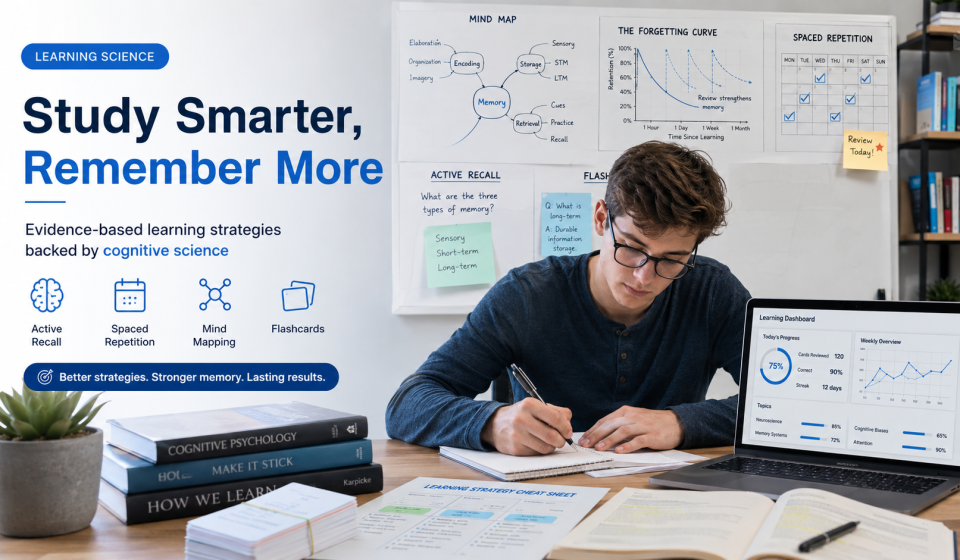

Learn how to study smarter using cognitive science-based techniques. Discover evidence-backed learning methods like Active Recall, Spaced Repetition, Interleaving, and Retrieval Practice to improve memory and academic performance.
Many students spend countless hours studying but still struggle to remember information during exams. The problem often isn’t the amount of time spent studying—it’s the study method itself. Cognitive science has revealed powerful insights into how the brain learns, stores, and retrieves information. By applying these evidence-based techniques, students can learn faster, remember more, and achieve better academic results.
If you want to maximize your learning efficiency, cognitive science offers proven strategies that can transform the way you study.
What Is Cognitive Science?
Cognitive science is the study of how the mind processes information, including learning, memory, attention, and problem-solving.
Researchers have discovered that certain study techniques are significantly more effective than traditional methods such as:
- Passive reading
- Highlighting entire textbooks
- Last-minute cramming
- Repeated rereading
Understanding how the brain learns can help students study more effectively.
Why Traditional Study Methods Often Fail
Many students rely on techniques that feel productive but produce limited results.
Common ineffective methods include:
- Rereading notes repeatedly
- Highlighting without reviewing
- Studying for long hours without breaks
- Memorizing without understanding
These approaches create familiarity but not deep learning.
1. Active Recall
Active Recall is one of the most effective learning techniques supported by cognitive science.
Instead of reviewing information passively, students actively retrieve information from memory.
Methods include:
- Flashcards
- Practice questions
- Self-quizzing
- Teaching concepts to others
Benefits
- Stronger memory retention
- Improved understanding
- Better exam performance
2. Spaced Repetition
Spaced Repetition involves reviewing information over increasing intervals.
Example schedule:
- Day 1
- Day 3
- Day 7
- Day 14
- Day 30
This technique combats the forgetting curve and strengthens long-term memory.
Benefits
- Long-lasting retention
- Reduced forgetting
- Efficient revision
3. Retrieval Practice
Retrieval Practice focuses on recalling information without looking at notes.
Examples include:
- Practice exams
- Memory exercises
- Writing summaries from memory
Every successful retrieval strengthens neural connections in the brain.
Benefits
- Better recall during exams
- Improved learning efficiency
- Enhanced understanding
4. Interleaving
Interleaving involves studying multiple related topics during a single session rather than focusing on only one subject.
Example:
Instead of:
- Math for 3 hours
Try:
- Math
- Science
- History
- Math again
Benefits
- Better problem-solving skills
- Improved knowledge transfer
- Greater adaptability
5. Elaboration
Elaboration means connecting new information to existing knowledge.
Ask questions such as:
- Why does this happen?
- How does this work?
- How is this related to what I already know?
Benefits
- Deeper understanding
- Better critical thinking
- Stronger memory formation
6. Dual Coding
Dual Coding combines verbal information with visual elements.
Examples include:
- Diagrams
- Flowcharts
- Mind maps
- Infographics
The brain processes information more effectively when presented in multiple formats.
Benefits
- Improved comprehension
- Faster learning
- Better recall
7. The Pomodoro Technique
While not strictly a cognitive science method, the Pomodoro Technique aligns with attention research.
Method:
- Study for 25 minutes
- Take a 5-minute break
- Repeat four times
- Take a longer break
Benefits
- Improved focus
- Reduced mental fatigue
- Better productivity
8. Metacognition
Metacognition means thinking about your thinking.
Successful students regularly ask:
- What do I understand?
- What am I struggling with?
- How can I improve?
Benefits
- Better self-awareness
- More efficient learning
- Improved academic performance
9. Self-Explanation
Explain concepts in your own words.
You can:
- Teach a friend
- Record explanations
- Write summaries
The process reveals knowledge gaps and strengthens understanding.
Benefits
- Deeper learning
- Better retention
- Improved communication skills
10. Practice Testing
Practice testing is one of the strongest predictors of exam success.
Methods include:
- Mock exams
- Online quizzes
- Sample questions
- Past papers
Benefits
- Reduced exam anxiety
- Improved recall
- Greater confidence
The Science Behind Memory Formation
Memory develops through three stages:
Encoding
Taking in new information.
Storage
Maintaining information over time.
Retrieval
Accessing information when needed.
Effective study techniques strengthen all three stages.
Common Study Mistakes Students Make
Avoid:
- Cramming before exams
- Passive rereading
- Multitasking
- Studying without breaks
- Ignoring sleep
These habits often reduce learning effectiveness.
How AI Can Support Cognitive Science-Based Learning
Modern AI tools can help students apply these techniques.
Examples include:
- Creating flashcards
- Generating quizzes
- Explaining difficult concepts
- Building study schedules
Popular tools include:
- ChatGPT
- Quizlet
- Notion AI
AI works best when combined with evidence-based learning strategies.
Sample Smart Study Routine
Morning
- Active Recall
- Practice questions
Afternoon
- Interleaving subjects
- Dual Coding activities
Evening
- Spaced Repetition review
- Self-explanation exercises
Weekly
- Practice tests
- Progress evaluation
This routine aligns closely with cognitive science principles.
Benefits of Cognitive Science-Based Learning
Students who use these methods often experience:
- Faster learning
- Better memory retention
- Improved grades
- Increased confidence
- Reduced study time
- Stronger critical thinking
Studying smarter often produces better results than studying longer.
Conclusion
Cognitive science has transformed our understanding of how learning works. Techniques such as Active Recall, Spaced Repetition, Retrieval Practice, Interleaving, and Dual Coding are backed by research and consistently outperform traditional study methods. By applying these strategies, students can learn more efficiently, retain information longer, and achieve better academic outcomes. Instead of relying on outdated study habits, embrace science-based learning techniques and unlock your full academic potential.
Sources
- American Psychological Association (APA)
- Khan Academy
- Coursera
- edX
- MIT OpenCourseWare
- Quizlet
- Google for Education
Frequently Asked Questions (FAQs)
What are cognitive science-based study techniques?
They are evidence-based learning methods developed through research on memory, attention, and learning processes.
What is Active Recall?
Active Recall involves retrieving information from memory through self-testing rather than rereading notes.
Why is Spaced Repetition effective?
It helps combat forgetting by reviewing information at increasing intervals over time.
What is Retrieval Practice?
Retrieval Practice strengthens memory by repeatedly recalling information without looking at study materials.
How does Interleaving improve learning?
Interleaving mixes different topics during study sessions, improving understanding and problem-solving skills.
What is Dual Coding?
Dual Coding combines visual and verbal information to improve learning and memory retention.
Are practice tests effective?
Yes. Practice testing is one of the most effective ways to improve recall and exam performance.
Can AI tools help with cognitive science-based learning?
Yes. AI can generate quizzes, flashcards, study plans, and explanations that support effective learning.
Why should students avoid cramming?
Cramming often leads to short-term memorization and poor long-term retention.
What is the best study technique according to cognitive science?
Active Recall and Spaced Repetition are widely considered among the most effective learning methods.