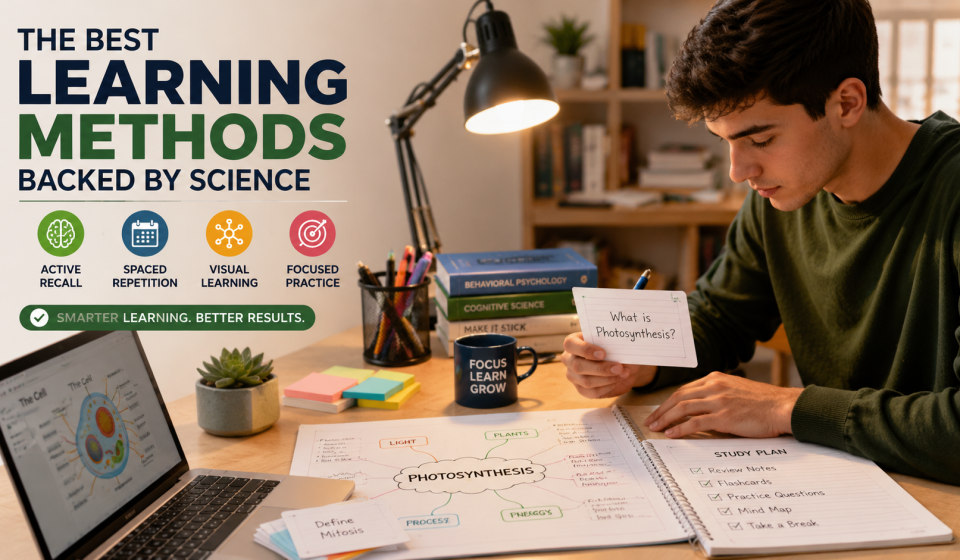

Discover the best learning methods backed by science to improve memory, focus, and academic performance. Learn proven study techniques that help students learn faster and retain information longer.
Learning effectively isn’t about spending endless hours with books—it’s about using techniques that work with how the brain naturally learns and remembers information. Scientific research has shown that certain study methods improve memory retention, understanding, and long-term academic success far better than passive reading or last-minute cramming.
Whether you’re a school student, college learner, or lifelong learner, adopting evidence-based learning strategies can help you study smarter, retain information longer, and achieve your educational goals more efficiently.
Why Science-Based Learning Methods Matter
Using proven learning techniques helps students:
- Improve memory retention
- Learn more efficiently
- Stay focused during study sessions
- Reduce exam stress
- Build long-term knowledge
- Increase academic performance
These methods help make studying more productive and enjoyable.
1. Active Recall
Active recall is one of the most effective learning strategies.
Instead of rereading notes, try to remember information without looking at your study material.
Examples include:
- Answering practice questions
- Using flashcards
- Self-quizzing
- Explaining concepts from memory
This strengthens long-term memory.
2. Spaced Repetition
Rather than studying everything at once, review information over increasing intervals.
Benefits include:
- Better long-term retention
- Reduced forgetting
- More efficient revision
- Improved exam preparation
Spaced repetition helps move information into long-term memory.
3. The Feynman Technique
The Feynman Technique involves explaining a concept using simple language.
Steps include:
- Study a topic
- Explain it as if teaching someone else
- Identify knowledge gaps
- Review and simplify again
Teaching strengthens understanding.
4. Interleaved Learning
Instead of studying one subject for hours, alternate between different topics.
Benefits include:
- Better problem-solving
- Improved understanding
- Greater adaptability
- Stronger long-term learning
Mixing subjects helps the brain recognize patterns.
5. Practice Testing
Testing yourself regularly is more effective than repeatedly reading notes.
Useful methods include:
- Mock exams
- Online quizzes
- Sample questions
- Self-assessment
Practice testing improves recall and confidence.
6. Mind Mapping
Mind maps organize information visually.
They help students:
- Connect ideas
- Understand relationships
- Improve creativity
- Simplify complex topics
Visual learning supports deeper understanding.
7. Chunking Information
Large amounts of information become easier to remember when divided into smaller sections.
Examples:
- Breaking chapters into topics
- Memorizing phone numbers in groups
- Learning vocabulary in categories
Chunking reduces cognitive overload.
8. Dual Coding
Dual coding combines words with visuals.
Examples include:
- Diagrams
- Flowcharts
- Infographics
- Illustrations
Combining text and images improves understanding.
9. Pomodoro Study Technique
Study in focused sessions followed by short breaks.
A common approach is:
- Study for 25 minutes
- Take a 5-minute break
- Repeat four times
- Take a longer break
This improves concentration and prevents burnout.
10. Elaboration
Elaboration means connecting new information to existing knowledge.
Ask questions such as:
- Why does this happen?
- How does this work?
- What is an example?
Making connections strengthens learning.
11. Consistent Revision
Reviewing material regularly is more effective than cramming before exams.
Revision should include:
- Weekly reviews
- Monthly summaries
- Practice questions
- Concept reviews
Consistency supports long-term retention.
12. Learning by Teaching
Teaching others helps reinforce your own understanding.
You can:
- Explain concepts to classmates
- Create presentations
- Record yourself teaching
- Participate in study groups
Teaching reveals areas that need improvement.
13. Healthy Study Habits
Your brain performs better when your body is healthy.
Maintain:
- Quality sleep
- Balanced nutrition
- Regular exercise
- Proper hydration
Healthy habits improve concentration and memory.
14. Minimize Multitasking
Focusing on one task at a time improves learning.
Avoid:
- Switching between subjects constantly
- Checking social media
- Watching television while studying
Single-tasking increases productivity.
15. Set Clear Learning Goals
Specific goals improve motivation and progress.
Examples include:
- Finish one chapter today
- Complete 20 practice questions
- Review yesterday’s notes
Clear goals help students stay organized and disciplined.
Common Study Mistakes to Avoid
Avoid these ineffective habits:
- Last-minute cramming
- Passive rereading
- Multitasking
- Skipping revision
- Studying without breaks
- Ignoring sleep
Replacing these habits with science-based methods leads to better results.
Benefits of Science-Based Learning Methods
Students often experience:
- Better memory
- Faster learning
- Improved focus
- Higher exam scores
- Reduced stress
- Greater confidence
Effective learning methods make studying easier and more rewarding.
Sources
- American Psychological Association (APA)
- Harvard University
- Stanford University
- UNESCO
- Edutopia
- Verywell Mind
- Mind Tools
Conclusion
The best learning methods backed by science focus on active participation, regular revision, and understanding rather than memorization alone. Techniques such as active recall, spaced repetition, practice testing, dual coding, and the Feynman Technique help students retain knowledge more effectively while improving confidence and academic performance. By incorporating these proven strategies into your daily study routine, you can study smarter, achieve better results, and build lifelong learning skills.
Frequently Asked Questions
1. What are the best learning methods backed by science?
Active recall, spaced repetition, practice testing, dual coding, interleaved learning, and the Feynman Technique are among the most effective science-backed learning methods.
2. Why is active recall more effective than rereading?
Active recall forces your brain to retrieve information from memory, strengthening long-term retention more effectively than passive reading.
3. What is spaced repetition?
Spaced repetition is a study method that reviews information at increasing intervals to improve long-term memory and reduce forgetting.
4. How does the Feynman Technique improve learning?
It helps students identify knowledge gaps by explaining complex topics in simple language, leading to a deeper understanding.
5. What is dual coding in learning?
Dual coding combines written information with visuals such as diagrams, charts, and illustrations to improve comprehension and memory.
6. Is the Pomodoro Technique good for studying?
Yes. The Pomodoro Technique improves focus by alternating short study sessions with regular breaks, helping reduce mental fatigue.
7. Why should students avoid multitasking while studying?
Multitasking divides attention, reduces concentration, and lowers learning efficiency. Focusing on one task at a time improves understanding.
8. How often should I revise my study materials?
Regular weekly and monthly revision sessions are more effective than cramming before exams and help strengthen long-term memory.
9. Can teaching others improve learning?
Yes. Teaching requires organizing and explaining information clearly, which reinforces understanding and reveals knowledge gaps.
10. What is the biggest benefit of using science-based learning methods?
Science-based learning methods improve memory retention, increase productivity, reduce study time, and help students achieve better academic performance.
Professional educational blog banner, focused student using flashcards, mind map, laptop, books, planner, and study notes, science-backed learning methods, active recall, spaced repetition concept, modern study desk, academic success, realistic photography, premium education theme, high quality, wide 16:9 ratio, featured blog image, 1200×675