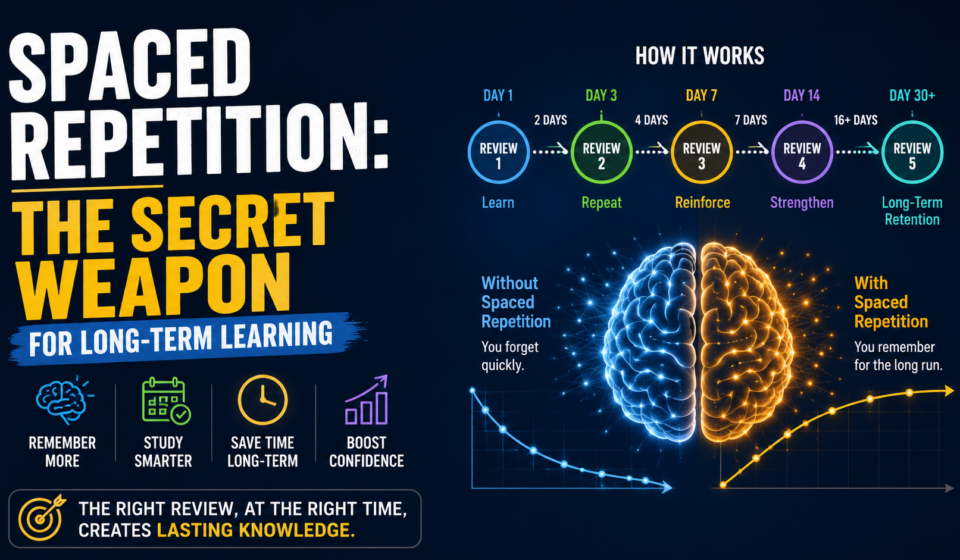

What if there was a study method so effective that it could help you remember information for years — or even a lifetime — with less total study time than traditional methods? That’s exactly what spaced repetition offers. Backed by decades of research in cognitive psychology, spaced repetition is one of the most powerful tools in a student’s arsenal. In this article, you’ll learn what spaced repetition is, how it works, and how to make it part of your study routine.
What Is Spaced Repetition?
Spaced repetition is a learning technique that involves reviewing information at increasing intervals over time. Instead of studying everything at once, you revisit material strategically — just before you’re about to forget it. This approach takes advantage of the brain’s natural memory patterns.
The Forgetting Curve
German psychologist Hermann Ebbinghaus discovered that we forget information rapidly after learning it, but each time we review it, the rate of forgetting slows. This decline in memory over time is called the forgetting curve, and spaced repetition is designed to fight it.
How Spacing Affects Memory
When you review material right after learning it, you reinforce the memory before it fully fades. Each review extends how long you remember the information. Over time, the intervals between reviews grow longer and longer.
The Science Behind Spaced Repetition
Research consistently shows that spaced practice outperforms massed practice — studying in concentrated blocks. Students who use spaced repetition retain information significantly better on long-term tests compared to those who cram.
Desirable Difficulty
Spaced repetition works partly because of ‘desirable difficulty.’ Reviewing information when it’s slightly hard to recall creates more durable memories than reviewing it when it’s easy. The mental effort of retrieval is what strengthens the memory.
Interleaving and Spacing
Combining spaced repetition with interleaving — mixing different topics in a single session — further improves long-term retention. It feels harder in the moment but leads to better outcomes.
How to Implement Spaced Repetition
You can use spaced repetition informally with a paper system, or use an app that automates the scheduling for you.
The Leitner System
This is a simple manual system using flashcard boxes. Cards you know go to the back (reviewed less often); cards you struggle with stay at the front (reviewed more often). It’s low-tech but effective.
Using Anki
Anki is the most popular app for spaced repetition. It uses an algorithm to calculate the optimal time to show you each flashcard. You rate how well you remembered each card, and the app schedules the next review accordingly.
What to Study with Spaced Repetition
Spaced repetition works best for material that needs to be recalled accurately and quickly.
Vocabulary and Language Learning
Language learners have used spaced repetition for decades. Apps like Duolingo and Memrise are built around it. It’s ideal for memorizing foreign words, grammar rules, and phrases.
Medical and Scientific Facts
Medical students swear by Anki for memorizing anatomy, pharmacology, and clinical facts. The sheer volume of information in medicine makes spaced repetition not just helpful but essential.
Tips for Getting the Most Out of Spaced Repetition
Like any tool, spaced repetition works best when used correctly.
Keep Cards Simple
The best flashcards test one concept at a time. Avoid cramming too much information on a single card.
If you can’t answer in 5–10 seconds, the card probably covers too much.
Be Consistent
Spaced repetition only works if you show up every day. Even 10–15 minutes of daily review is far more effective than an hour-long session once a week.
Conclusion
Spaced repetition is one of those rare techniques where doing less work more smartly gives you dramatically better results. It harnesses the brain’s natural learning rhythms to build knowledge that lasts. Whether you’re learning a language, preparing for medical boards, or studying for your finals, spaced repetition can transform the way you learn. Start today — your future self will remember.
Frequently Asked Questions (FAQs)
Q1: Is spaced repetition effective for all subjects?
A: It works best for fact-based recall. It’s less suited for complex problem-solving or essay-based subjects, though it can still support vocabulary and key concepts in those fields.
Q2: How often should I do spaced repetition?
A: Daily sessions of 10–20 minutes are ideal. Consistency is more important than session length.
Q3: What is the best spaced repetition app?
A: Anki is widely regarded as the most powerful free option. Quizlet, RemNote, and Memrise also offer good spaced repetition features.
Q4: How long until spaced repetition shows results?
A: You’ll notice improved retention within days. Significant long-term benefits build over weeks and months of consistent practice.
Q5: Can spaced repetition replace other study methods?
A: No, it works best in combination with active recall, practice testing, and conceptual understanding. Use it as a core part of a broader study strategy.