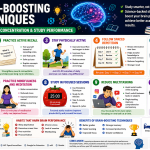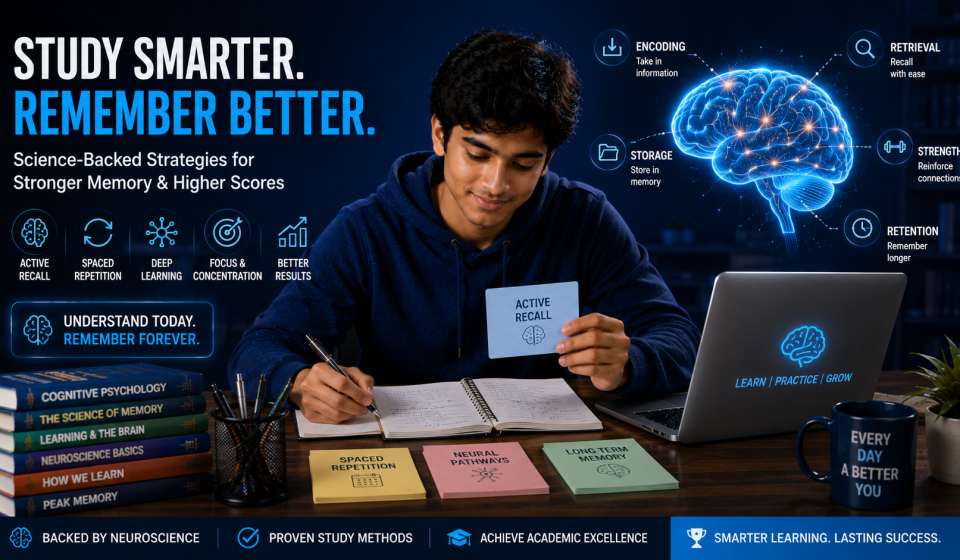

Discover the science of learning and memory. Learn proven techniques like active recall, spaced repetition, sleep optimization, and focused study methods to remember more and improve academic performance.
Have you ever spent hours studying only to forget most of the information a few days later? You’re not alone. Many students struggle with memory retention, not because they lack intelligence, but because they don’t understand how the brain learns and stores information.
The science of learning reveals that effective studying is not about spending more time with books—it’s about using methods that work with the brain’s natural memory processes. By understanding how learning works, students can remember more, forget less, and achieve better academic results.
Understanding How Memory Works
Memory is the brain’s ability to store, retain, and retrieve information.
Learning typically occurs in three stages:
Encoding
The brain receives and processes new information.
Storage
Information is stored in short-term or long-term memory.
Retrieval
The brain recalls stored information when needed.
Successful learning depends on strengthening all three stages.
Why We Forget Information
Psychologists have found that forgetting is a natural process.
Common reasons include:
- Lack of revision
- Passive reading
- Information overload
- Poor sleep
- Stress
- Lack of practice
Without reinforcement, the brain gradually removes information it considers unimportant.
The Forgetting Curve
Research shows that people forget a significant amount of new information shortly after learning it.
Without revision:
- Information fades quickly
- Recall becomes more difficult
- Learning efficiency decreases
This is why regular review is essential for long-term memory.
1. Use Active Recall
Active Recall is one of the most effective learning methods supported by cognitive science.
Instead of rereading notes, attempt to retrieve information from memory.
Examples:
- Self-quizzing
- Flashcards
- Practice questions
- Explaining concepts without notes
Benefits:
- Stronger memory pathways
- Better recall
- Improved exam performance
2. Practice Spaced Repetition
Spaced Repetition strengthens long-term memory by reviewing information over time.
Example schedule:
- Day 1: Learn
- Day 3: Review
- Day 7: Review
- Day 14: Review
- Day 30: Review
Benefits:
- Reduced forgetting
- Improved retention
- More efficient learning
3. Apply the Feynman Technique
Named after physicist Richard Feynman, this method improves understanding and memory.
Steps:
- Learn a topic.
- Explain it simply.
- Identify knowledge gaps.
- Review and simplify further.
Teaching is one of the most effective ways to learn.
4. Focus on Understanding, Not Memorization
Students often try to memorize facts without understanding concepts.
The brain remembers information better when it understands:
- Relationships
- Patterns
- Real-world applications
Meaningful learning creates stronger memory connections.
5. Use Multiple Learning Methods
Combining learning styles improves retention.
Examples:
- Reading
- Writing
- Listening
- Watching videos
- Solving problems
The more ways the brain processes information, the stronger the memory becomes.
6. Get Enough Sleep
Sleep plays a crucial role in memory consolidation.
Benefits:
- Stronger memory formation
- Better concentration
- Faster learning
- Improved recall
Most students should aim for 7–9 hours of quality sleep every night.
7. Exercise Regularly
Physical activity improves brain function.
Benefits include:
- Increased blood flow
- Better focus
- Enhanced memory
- Reduced stress
Exercise supports both learning and mental health.
8. Reduce Multitasking
The brain performs best when focusing on one task at a time.
Multitasking often leads to:
- Lower concentration
- Reduced retention
- More mistakes
Single-tasking improves learning efficiency.
9. Use Visual Learning Techniques
Visual information is often easier to remember.
Helpful tools include:
- Mind maps
- Diagrams
- Charts
- Infographics
Visual learning strengthens memory through association.
10. Test Yourself Frequently
Testing is not only an assessment tool—it is also a learning tool.
Benefits:
- Better recall
- Identification of weak areas
- Increased confidence
- Improved retention
Frequent self-testing strengthens long-term memory.
11. Take Strategic Breaks
The brain needs recovery periods to process information.
Try:
- Pomodoro Technique
- Short walks
- Stretching
- Relaxation exercises
Breaks improve concentration and productivity.
12. Manage Stress Effectively
High stress levels can negatively affect memory.
Helpful strategies include:
- Meditation
- Deep breathing
- Exercise
- Time management
A calm mind learns more effectively.
13. Connect New Knowledge to Existing Knowledge
The brain remembers information better when it is linked to what you already know.
Examples:
- Real-life examples
- Personal experiences
- Related concepts
Strong connections create stronger memories.
14. Stay Curious
Curiosity increases attention and engagement.
Students who actively explore topics often:
- Learn faster
- Retain more information
- Enjoy learning more
Interest enhances memory formation.
15. Be Consistent
Learning is a process, not an event.
Students who study consistently tend to:
- Remember more
- Experience less stress
- Achieve better results
Small daily efforts produce long-term success.
Benefits of Understanding the Science of Learning
Students who apply evidence-based learning strategies often experience:
- Better memory retention
- Improved academic performance
- Faster learning
- Reduced study time
- Increased confidence
- More effective revision
Learning how to learn is one of the most valuable skills a student can develop.
Common Learning Mistakes to Avoid
Avoid these habits:
- Passive reading
- Cramming before exams
- Poor sleep habits
- Multitasking
- Lack of revision
- Ignoring practice tests
- Studying without goals
These mistakes often reduce retention and learning effectiveness.
Sources
Conclusion
The science of learning shows that successful studying is not about spending endless hours with textbooks. It is about understanding how memory works and using proven techniques such as Active Recall, Spaced Repetition, self-testing, quality sleep, and focused practice. By applying these evidence-based strategies, students can remember more information, forget less, and achieve greater academic success. The most successful learners are not always the smartest—they are often the ones who understand how learning truly works.
Frequently Asked Questions
What is the science of learning?
The science of learning studies how the brain acquires, stores, and retrieves information effectively.
Why do students forget what they learn?
Students often forget due to lack of revision, poor sleep, passive learning, and information overload.
What is the most effective learning technique?
Active Recall and Spaced Repetition are among the most effective evidence-based learning methods.
How does sleep affect memory?
Sleep helps consolidate information into long-term memory and improves recall.
What is Active Recall?
Active Recall involves retrieving information from memory through self-testing instead of passive review.
What is Spaced Repetition?
Spaced Repetition is a learning method that reviews information at increasing intervals to improve retention.
Can exercise improve learning?
Yes. Exercise improves brain function, concentration, and memory performance.
Why is multitasking bad for studying?
Multitasking divides attention and reduces learning efficiency and memory retention.
How often should students revise?
Regular reviews over days and weeks are more effective than cramming before exams.
What is the Feynman Technique?
The Feynman Technique involves explaining concepts in simple language to improve understanding and memory.